The Airports Council International Asia-Pacific & Middle East (ACI APAC & MID) recently released the Post-Pandemic Travel Retail Report, indicating that the airport retail landscape has undergone a fundamental transformation.
The report points out that young travellers have become the dominant force in airport consumption. Passenger composition, behaviour and preferences have emerged as decisive factors in airport travel retail performance, rather than sheer passenger traffic alone.
Currently, the strongest spending power comes from travellers from China, India, the United Arab Emirates and the Kingdom of Saudi Arabia. Chinese luxury consumption is twice the Asia-Pacific average.
The research report was jointly produced by ACI APAC & MID and consultancy Auran and Steer. It covers 36 major airports across 21 countries and incorporates insights from retailers and travellers.
Survey findings show:
- 56% of surveyed airports reported that their commercial revenue is now higher than in 2019.
- 44% of airports expect commercial revenue per passenger to increase over the next 12 months.
- Airports identified perfumes and cosmetics as the strongest-performing category since 2019.
- Passenger demographics and price competitiveness are key factors influencing retail performance.
In terms of consumer age structure, compared with Baby Boomers, younger travellers, especially Generation Z and Millennials, have surpassed older generations to become the main drivers of airport spending. Comparisons across age groups in specific categories are as follows:
- Generation Z and Millennials spend five times as much as Generation X and Baby Boomers;
- Generation Z are four times more likely than Baby Boomers to purchase electronics;
- Generation Z are five times more likely than Baby Boomers to purchase luxury goods;
- Baby Boomers are five times more likely than Generation Z to purchase alcohol;
- Baby Boomers are four times more likely than Generation Z to purchase confectionery.
Unlike older generations, who are more price-sensitive and relatively conservative in category choices, Millennials and Generation Z are the primary drivers of consumption in luxury goods, perfumes and cosmetics. They also show a strong preference for localised and culturally relevant products, with demand shifting towards destination-related purchases that offer storytelling and authenticity.
Stefano Baronci, Director General of ACI APAC & MID, stated: “This study highlights a structural shift: as passenger behaviour becomes increasingly segmented, revenue outcomes are increasingly determined by who the passengers are, not just how many there are. This shift is critical, given that airport operations involve high fixed costs and long-term investments. When financial growth is no longer driven by passenger volumes, optimising commercial performance becomes central to financial resilience. In this context, non-aeronautical revenues, travel retail and duty-free operations play a crucial role in airport business models. Airports that align their commercial strategies with evolving passenger behaviour are better positioned to manage revenue volatility, sustain investment capacity and remain competitive over the long term.”
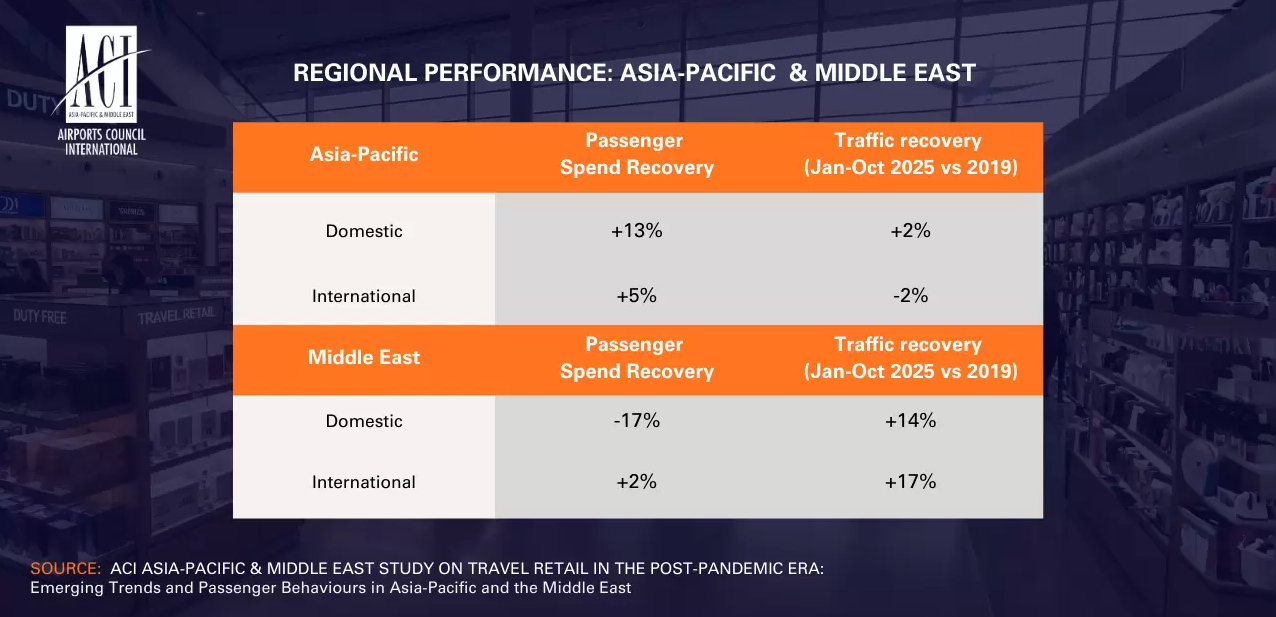
By region, from January to October 2025, domestic passenger traffic in the Asia-Pacific region grew by only 2%, yet passenger spending per capita increased by a robust 13% compared with the same period in 2019, reflecting shifts in consumer behaviour and an increase in high-value purchases. Luxury goods (+9%) and local products (+7%) were the main growth drivers.
In the Middle East, spending on electronics rose by 14%, as travellers increasingly took advantage of tax benefits and sought exclusive products unavailable in shopping malls, reflecting a stronger focus on value-for-money in airport retail.
Duty-free shops have become financial pillars for airports across the Asia-Pacific and Middle East regions, contributing substantial retail revenue and driving commercial performance at major hub airports.
In the Middle East, duty-free is not only important but central to airport economies. Duty-free sales account for a significant share of total sales across the region: Saudi Arabia (31%), the United Arab Emirates (36%), Qatar (38%), Bahrain (34%) and Oman (31%). Airports in the Middle East are also highly dependent on duty-free revenue, with Saudi Arabia and Qatar at around 60%, and the United Arab Emirates, Bahrain and Oman all exceeding 50%.
Duty-free products in the Middle East are primarily confectionery and perfumes, while airports in the Asia-Pacific and Oceania regions show a stronger preference for premium products and alcohol.
The report also notes that the strongest-spending groups now come from China, India, the United Arab Emirates and the Kingdom of Saudi Arabia:
- China: Leading the recovery in both domestic and overseas consumption, with luxury spending at twice the Asia-Pacific average.
- India: Experiencing significant growth in international and duty-free spending, mainly driven by brand preferences and tax incentives.
- The United Arab Emirates and the Kingdom of Saudi Arabia: Outbound travellers from these countries have become major spending forces, characterised by high disposable income and a strong gifting culture.
Although digital usage is increasing, particularly among younger travellers, the majority of purchases still take place in physical stores.
According to the report, around 70% of airport purchases are driven by impulse. Digital interaction plays mainly a supporting role and currently generates only an additional 2% in sales. Product selection (39%) and price and promotions (29%) together account for nearly 70% of purchase motivations. Experience alone influences only 20% of purchasing decisions, while convenience, efficiency and seamless processes are more important than environment or ambience.
Although 65% of Generation Z travellers are willing to pay a premium for sustainable products, only 20% of airports currently regard sustainability as a core factor influencing retail decisions, revealing a clear gap between traveller expectations and airport strategies.
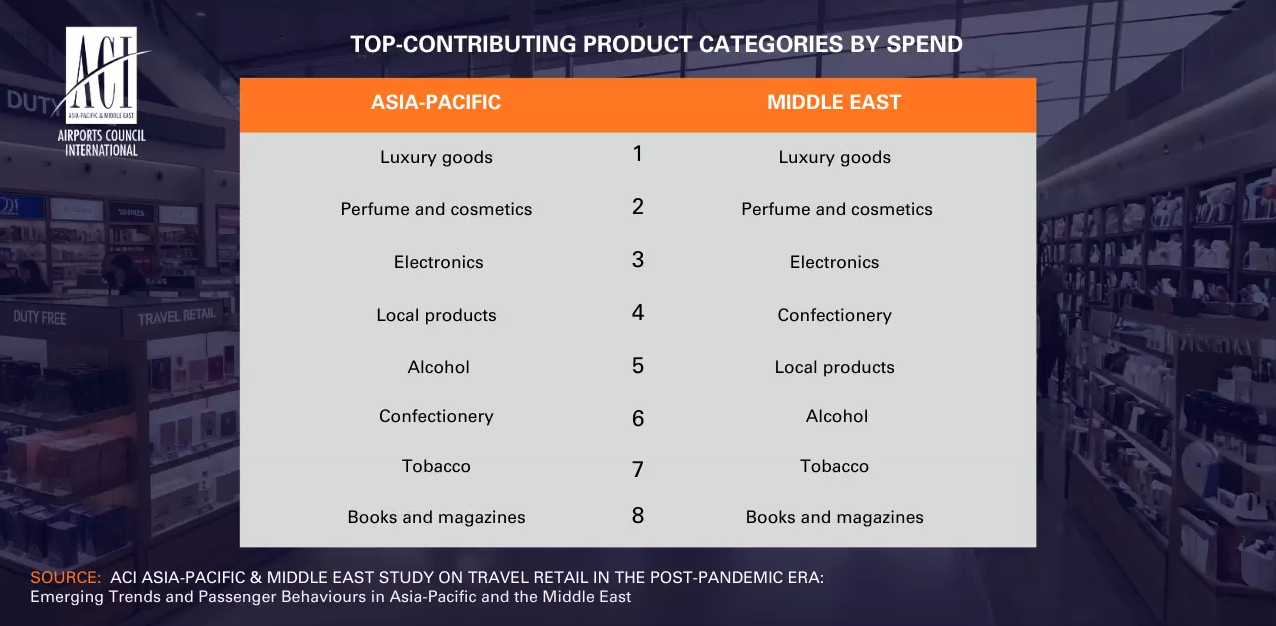
Across the Asia-Pacific and Middle East regions, the top-performing airport retail categories are highly consistent: luxury goods and perfumes and cosmetics rank among the top two in both regions, with electronics typically in third place due to price advantages and convenience. These three categories together generate the highest net profit margins for airports.
Beyond premium categories, regional preferences are also emerging. Local products perform strongly in the Asia-Pacific, while confectionery and impulse gifts are more popular in the Middle East.
| Source: Original report
| Image Credit: Original report
| Editor: LeZhi