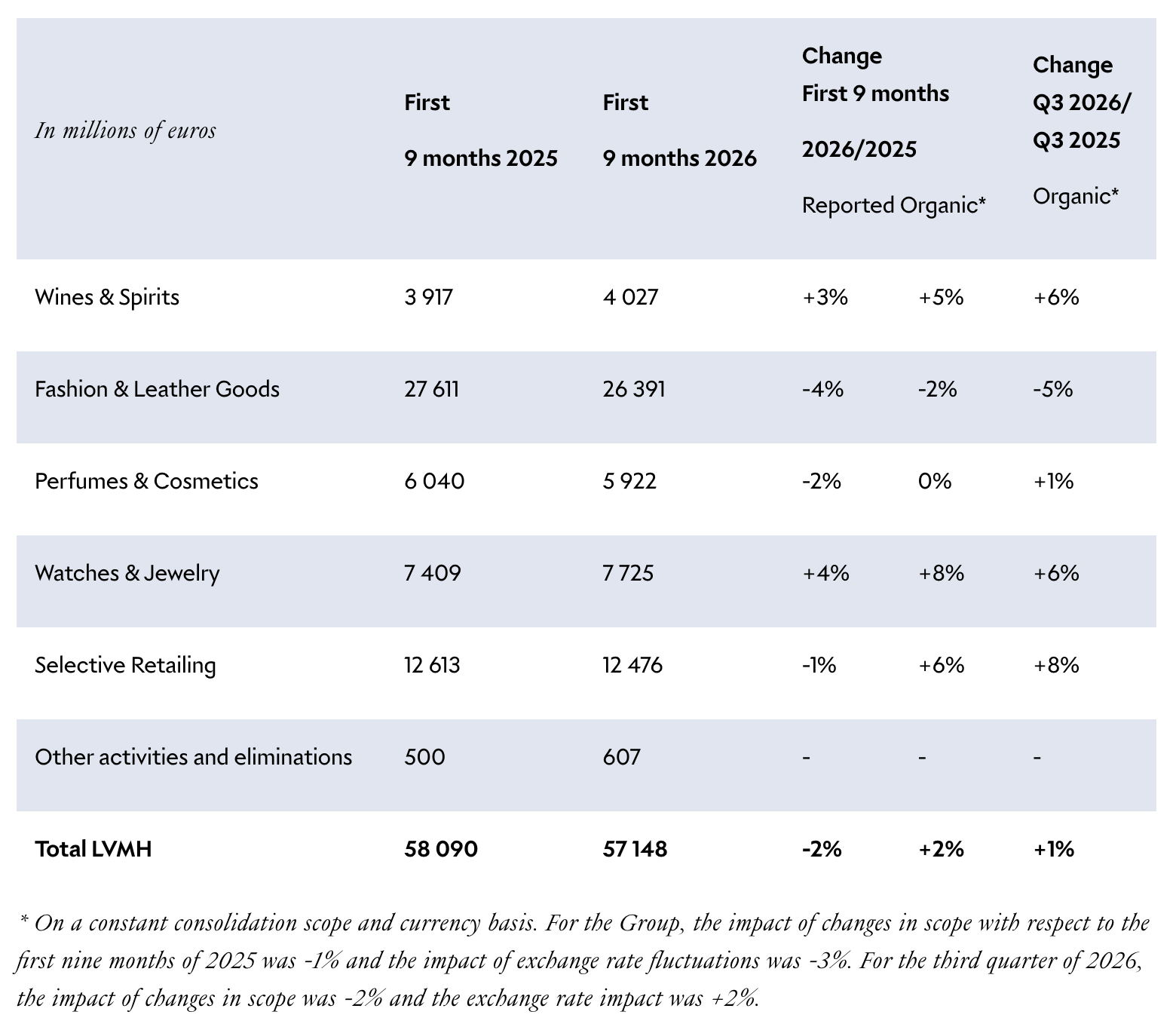
After the Paris stock market closed on October 12, French luxury giant LVMH Moët Hennessy Louis Vuitton released preliminary results for the first nine months of fiscal 2026, ended September 30. Total revenue fell 2% year on year to EUR 57.148 billion, with organic growth of 2%. Third-quarter revenue reached EUR 18.504 billion, up 1% organically year on year, slowing from 3% growth in the second quarter. The group said that third-quarter organic growth reflected the impact of a “less buoyant” environment in China on its business, while the US, Europe and Japan delivered good growth.
Revenue in Asia, excluding Japan but including China, fell 5% organically year on year in the third quarter. The region recorded growth of 7% and 4% in the first and second quarters of this year, respectively, compared with 2% growth in the third quarter of last year.
Cécile Cabanis said on the earnings call that Asia’s third-quarter performance was weighed down by a sharp deterioration in Chinese consumer confidence driven by macroeconomic factors, with a clear impact on discretionary spending. News out of China over the summer was unfavourable, and consumers’ “feel-good factor” began to deteriorate at the start of the quarter. Cabanis also noted that trends improved towards the end of the quarter, with September performing better than the quarterly average, including among Chinese customers both at home and abroad. “We hope this will subside, but we don’t know when. We will focus on what we can control, namely self-help measures.” She said that changes in China’s consumer environment had delayed the recovery, adding that “there are no structural or specific factors preventing a recovery; it simply needs more time.”
The impact was most pronounced in the Fashion and Leather Goods division, led by Louis Vuitton and Dior, where third-quarter revenue fell 5% organically year on year, after returning to organic growth in the second quarter (+1%). Responding to an analyst’s question about the division, Cabanis revealed that demand from Chinese customers fell by a mid-teens percentage in the third quarter, with a double-digit decline in spending within China and a mid-single-digit decline overseas. Demand from US customers remained solid, growing at a mid-single-digit rate.
Despite the slowdown, LVMH has now recorded positive organic growth for five consecutive quarters. The group’s revenue fell 4% organically year on year in the second quarter of 2025 before returning to growth in the third quarter of that year.
LVMH’s Third-Quarter Performance Highlights
Group level: Revenue grew 1% organically year on year in the third quarter, with currency effects turning positive
Regional level: Solid growth in the US, Europe and Japan
Divisional level:
- Strong organic growth in Wines and Spirits
- Good momentum in the creative renewal of Fashion and Leather Goods, with a strong performance from Loro Piana
- Strong jewellery performance within Watches and Jewellery, with continued success for iconic collections
- Within Perfumes and Cosmetics, Parfums Christian Dior and Guerlain performed well, supported by successful innovations
- Strong growth at Sephora, with good momentum across regions and brands
Regional Performance
In the first nine months of the year, organic revenue grew 4% year on year in the US and 5% in Japan. Asia, excluding Japan but including China, grew 3% year on year, while Europe was flat.
In the third quarter, revenue grew 5%, 6% and 4% year on year in the US, Japan and Europe, respectively, while Asia excluding Japan declined 5%.
Cabanis said on the earnings call that growth in Europe accelerated markedly in the third quarter, following a flat second quarter, with improving trends across all divisions. Growth in the US and Japan was slightly above their respective averages for the year to date. Trends in the US remained relatively stable, while fluctuations in Japan largely reflected significant differences in the quarterly comparison bases.
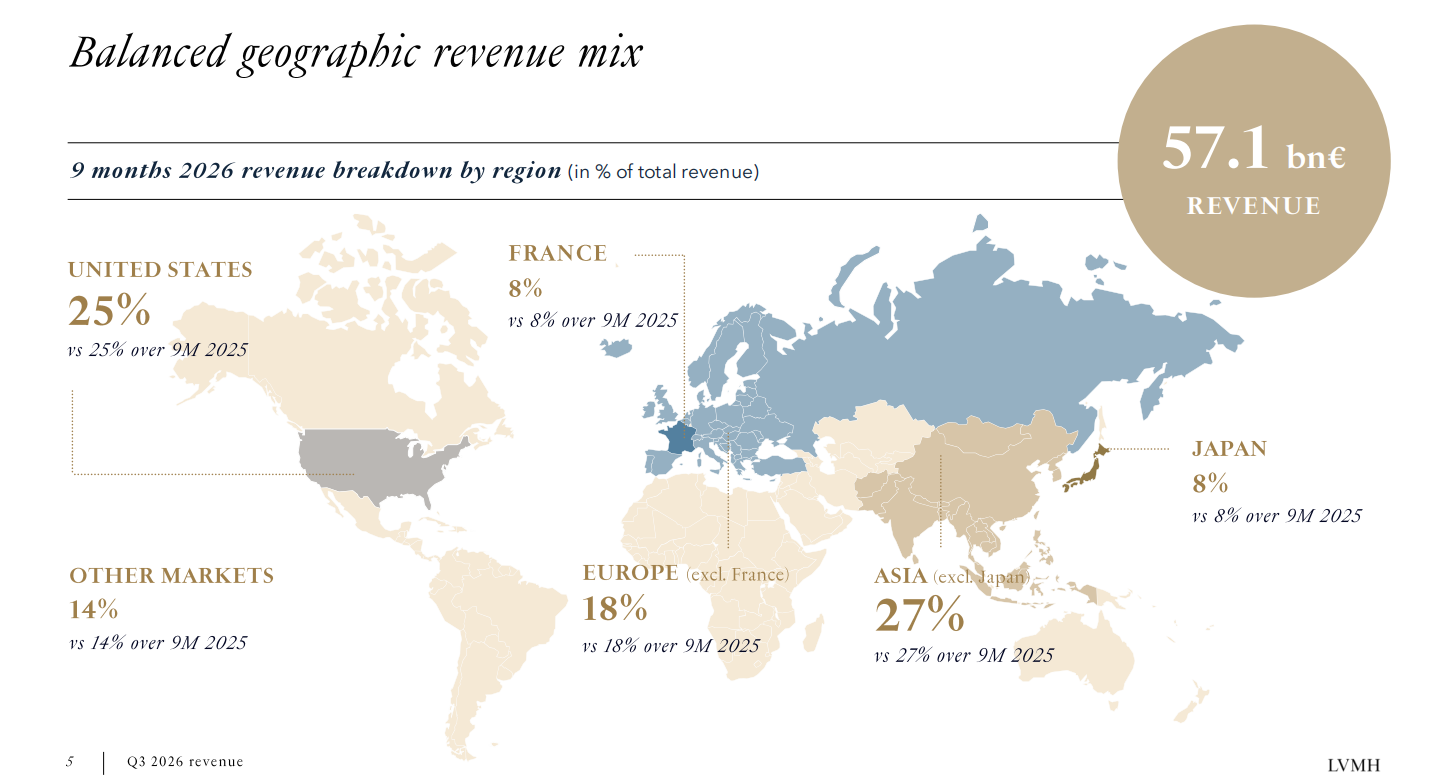
The group’s geographical revenue mix was unchanged from the same period last year. The US accounted for 25%, France for 8%, Europe excluding France for 18%, Japan for 8%, Asia excluding Japan for 27%, and other markets for 14%.
Performance by Division
— Wines and Spirits
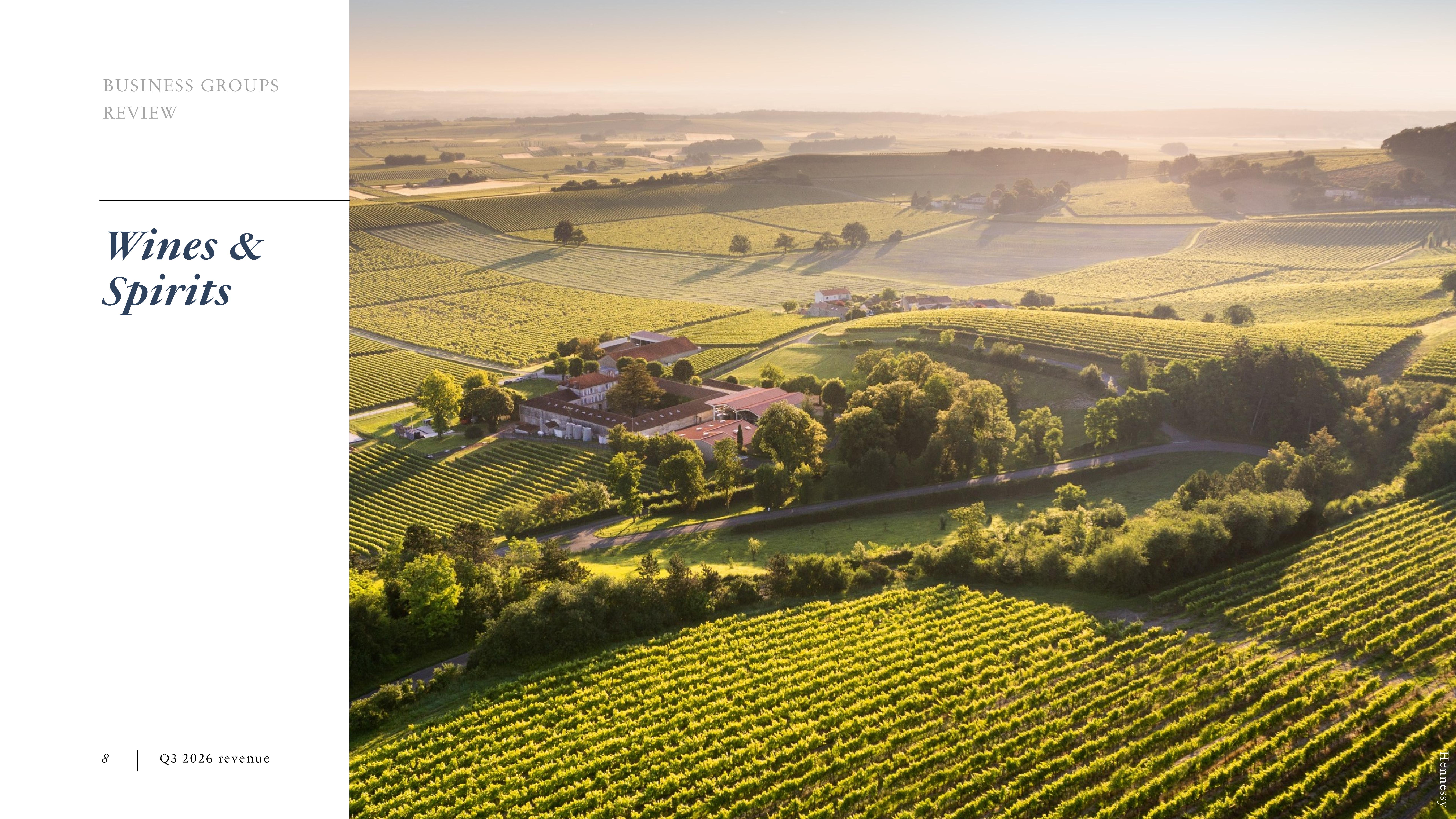
The Wines and Spirits division recorded organic revenue growth of 5% year on year in the first nine months, reaching EUR 4.027 billion (up 3% on a reported basis), with third-quarter organic growth of 6% year on year. By category, Champagne and Wines revenue reached EUR 2.229 billion, up 6% organically, while Cognac and Spirits revenue totalled EUR 1.798 billion, up 4% organically.
Rodolphe Ozun, Director of Financial Communications, said on the earnings call that all the group’s major champagne brands achieved growth in the third quarter. Dom Pérignon and Krug continued to lead the way, contributing to a favourable product mix. In the first nine months, champagne volumes grew at a low-single-digit rate, with pricing also making a low-single-digit contribution.
The champagne business continued to show signs of recovery observed since the start of the year, particularly in Europe. Moët & Chandon maintained high visibility in its second season as the Official Champagne of Formula 1 Grand Prix races. Rosé wines maintained good momentum, with continued progress in Provence rosé wines. The new low-alcohol Chandon Spritz range was well received.
Hennessy cognac maintained good momentum in Asia, particularly China, while the US market benefited from the launch of the new V.S. ready-to-drink cocktail range. Glenmorangie and Belvedere performed well and continued to innovate.
— Fashion and Leather Goods
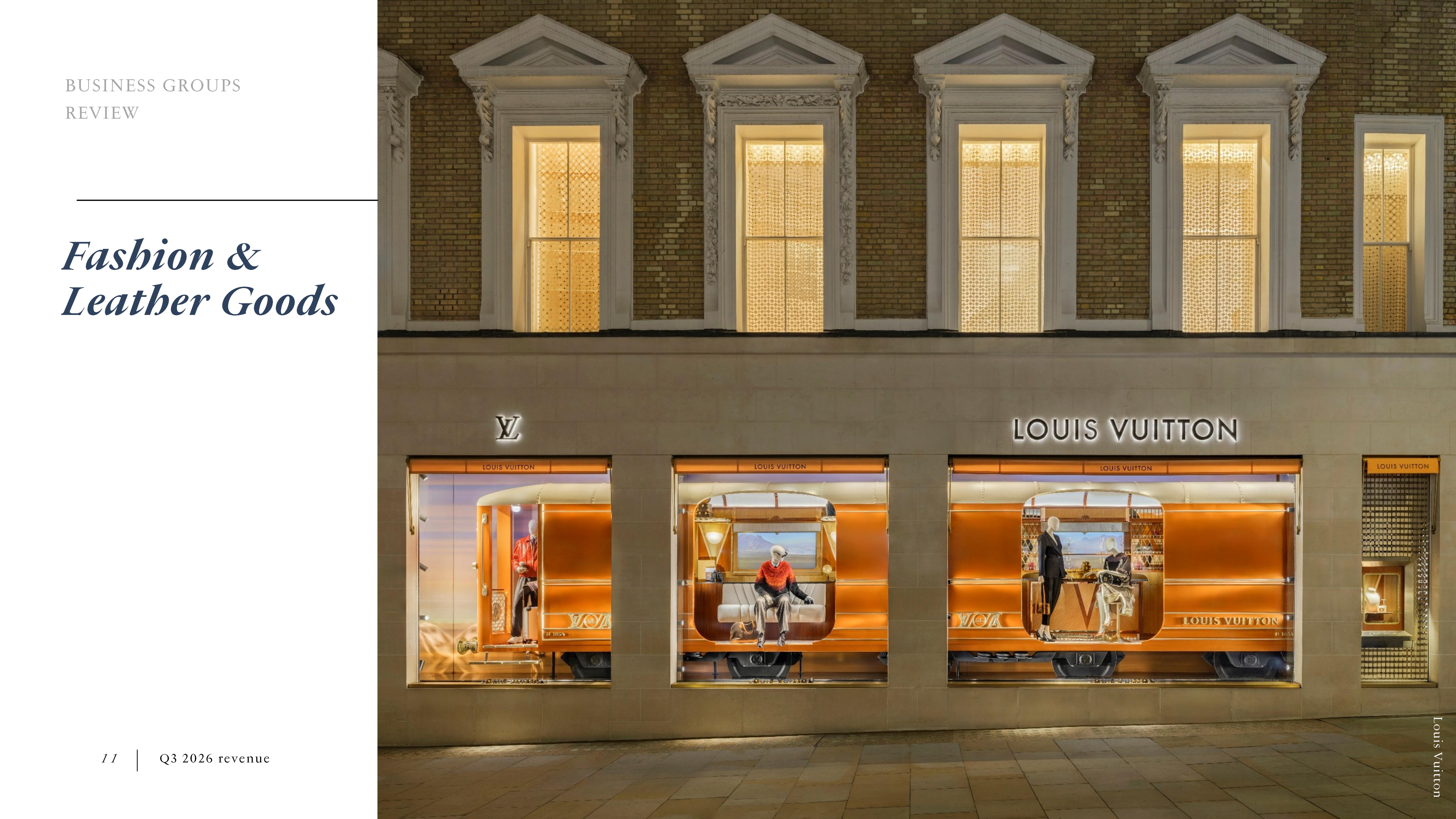
Creative renewal across the Fashion and Leather Goods division’s brands yielded results. Revenue fell 2% organically year on year in the first nine months to EUR 26.391 billion (down 4% on a reported basis), including a 5% organic decline in the third quarter. The division continued to benefit from a buoyant US market but was affected by slowing demand in China during the third quarter.
Cabanis revealed on the earnings call that Louis Vuitton performed slightly below the divisional average in the third quarter. A one-off logistics and transport disruption caused by a freight forwarder reduced the brand’s organic growth for the quarter by just over one percentage point. Dior’s third-quarter revenue was flat year on year, while revenue for the first nine months grew, including double-digit growth in revenue from US customers. Loro Piana and Rimowa outperformed the divisional average.
Louis Vuitton paid tribute to its iconic handbags to mark the 130th anniversary of the Monogram, reinterpreting the original canvas used for its first trunks through the new Monogram Emblème jacquard weave. Recent handbag launches proved successful. The women’s ready-to-wear collections designed by Creative Director Nicolas Ghesquière and the men’s collections designed by Pharrell Williams both maintained good momentum. The brand continued to offer distinctive in-store experiences, including the large LV The Place flagship in Seoul and new immersive, travel-inspired spaces around the world. Recently opened stores performed well.
In China, Louis Vuitton opened a new store at Changchun MixC in the third quarter, which Ozun said on the earnings call had made a good start. Addressing market attention on Louis Vuitton’s store closures in China, Cabanis said that the brand had opened a new store just one week after a closure, and that its total store floor space in China had remained unchanged over the past 12 months. The brand takes a pragmatic approach to adjusting its store network as leases expire. On more aggressive short-term measures such as price cuts, she said, “We don’t think that would be advisable,” as any action must take the brand’s desirability into account. Louis Vuitton will continue to balance brand elevation with new customer recruitment. LOUIS VUITTON
Christian Dior benefited from the major success of Creative Director Jonathan Anderson’s designs, with particularly strong demand for ready-to-wear and leather goods, led by women’s handbags and ready-to-wear. Following the opening in Osaka in May, another House of Dior flagship opened on Via Monte Napoleone in Milan in September.
Loro Piana delivered an excellent performance. In Milan, it presented Solutions For, its latest ready-to-wear collection centred on pieces combining functionality and creativity, in an immersive setting. It also opened a new centre for knitwear excellence in Ghemme, Italy. LVMH
- Celine: Collections designed by Creative Director Michael Rider proved highly successful, with growth accelerating. The brand launched a silk-themed campaign. Cabanis revealed on the earnings call that Celine’s footwear business achieved double-digit growth, while the brand maintained strong momentum in the US.
- Fendi: Creative Director Maria Grazia Chiuri presented her first collections, with her reinterpretation of the Baguette bag proving successful.
- Loewe: Co-Creative Directors Jack McCollough and Lazaro Hernandez continued the creative renewal of the collections. The Amazona 180 enjoyed growing success, and the brand launched the Whisker bag.
- Givenchy: Ready-to-wear designed by Creative Director Sarah Burton performed well.
- Rimowa: Strong growth, with the launch of Classic Titanium and Grid luggage.
- Berluti: A solid performance.
On September 1, LVMH also completed the sale of Marc Jacobs to US brand management company WHP Global.
— Perfumes and Cosmetics
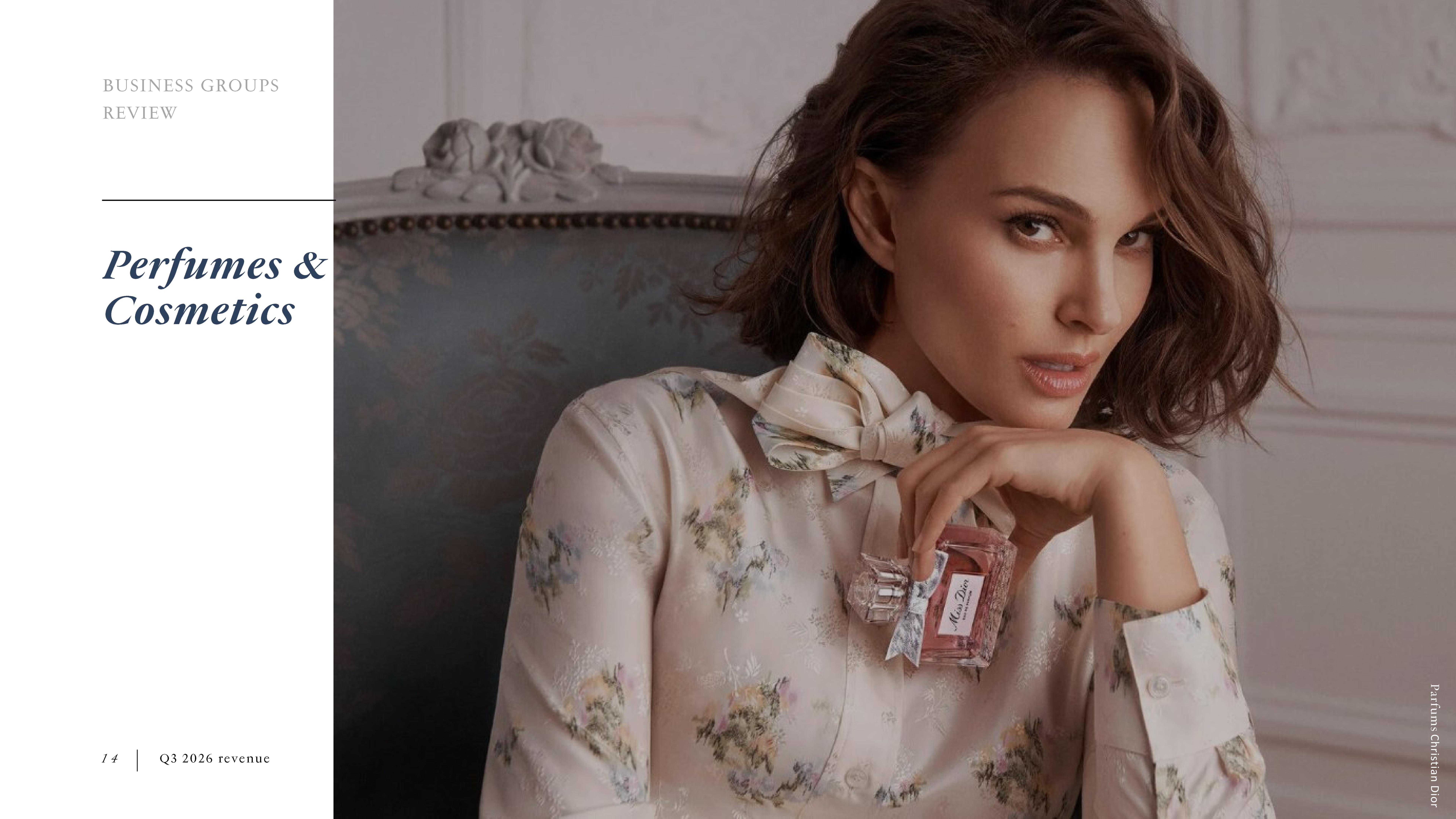
The Perfumes and Cosmetics division recorded flat organic revenue year on year (0%) in the first nine months, at EUR 5.922 billion (down 2% on a reported basis), including organic growth of 1% in the third quarter. The division maintained its highly selective retail strategy, with its historic brands performing well. Rodolphe Ozun said on the earnings call that fragrance had been the division’s main growth driver so far this year.
Parfums Christian Dior benefited from the launches of J’adore Intense, Sauvage Extrait and eau de parfum versions of Dior Addict. Its high perfumery collection, La Collection Privée, introduced new signature scents. Forever and Backstage drove good momentum in makeup, also contributing to the brand’s performance, while the Prestige skincare line performed well.
Guerlain achieved substantial growth, driven by the launch of L’Heure Bleue, the success of its L’Art & La Matière and Aqua Allegoria fragrance collections, and accelerating growth in its iconic Rouge G lipstick. The Orchidée Impériale skincare line also performed well.
- Parfums Givenchy: Focused on developing L’Interdit.
- Maison Francis Kurkdjian: Expanded its Oud collection.
- Acqua di Parma: Celebrated its 110th anniversary and launched Cedro Virtuoso eau de parfum.
- Benefit: Launched the new The POREfessional Degunker cleansing range.
- Loewe Perfumes: Added new fragrances to its Crafted collection.
— Watches and Jewellery
The Watches and Jewellery division recorded organic revenue growth of 8% year on year in the first nine months, reaching EUR 7.725 billion (up 4% on a reported basis), including organic growth of 6% in the third quarter, compared with 11% in the second quarter. Growth was driven by a “very good” performance in jewellery.
Cécile Cabanis said on the earnings call that the division’s slower third-quarter growth reflected both the impact of macroeconomic factors on Chinese demand and a slowdown in US growth between the second and third quarters, with Tiffany facing a high comparison base. In addition, as gold prices stabilise, the contribution to growth from earlier price increases introduced to offset rising gold costs is expected to diminish.
Tiffany & Co. continued to successfully strengthen its iconic product lines, particularly HardWear, Knot and Sixteen Stone, while renovating its store network. Following its launch in New York, the Blue Book 2026: Hidden Garden high jewellery collection presented its autumn chapter in Venice to a highly positive reception from clients. The brand also held an exhibition of Jean Schlumberger’s archival creations at the Musée des Arts Décoratifs in Paris (MAD Paris).
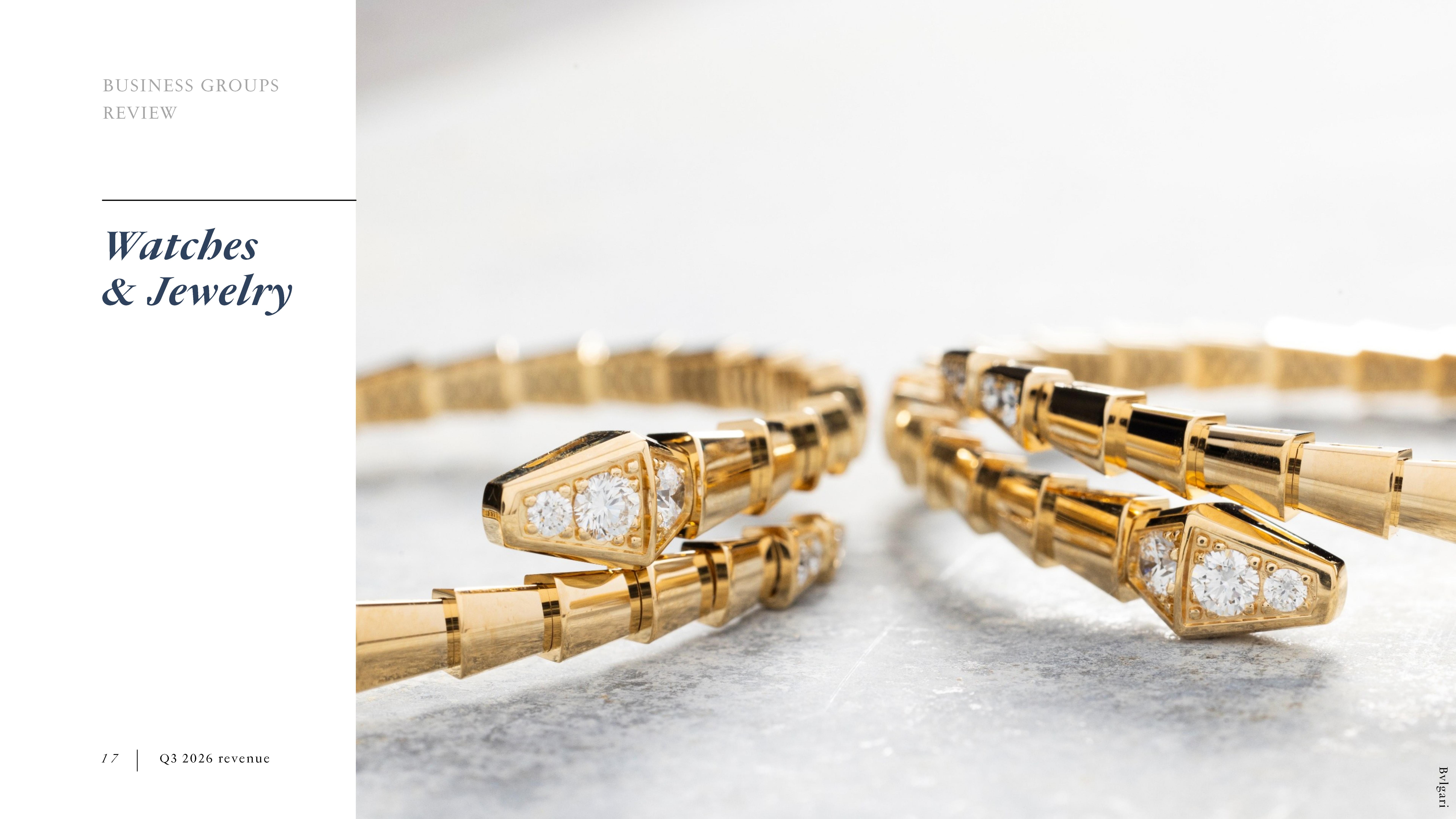
BVLGARI unveiled its new Eclettica high jewellery and prestige watch collection, with the high jewellery collection generating record revenue. Bvlgari Vimini also made a successful debut. The Kaleidos and Serpenti Infinito exhibitions continued their global tours, with Kaleidos stopping in Shanghai, while a large-scale installation unveiled in New York paid tribute to the brand’s iconic Serpenti design.
Chaumet continued to develop its Bee de Chaumet collection, introducing its first Bee de Chaumet high jewellery set crafted from traceable gold, alongside the new A Journey Through Nature high jewellery collection. Fred celebrated its 90th anniversary with the launch of the Monsieur Fred Golden Light high jewellery collection.
In watches, TAG Heuer maintained high visibility at Formula 1 Grand Prix races, particularly as Title Partner in Madrid. Hublot collaborated with artist Jeff Koons and appointed him a global brand ambassador, while Zenith introduced new models in its G.F.J. and Chronomaster collections.
— Selective Retailing
The Selective Retailing division recorded organic revenue growth of 6% year on year in the first nine months, reaching EUR 12.476 billion (down 1% on a reported basis, including a -4% impact from changes in consolidation scope and a -3% currency impact), with organic growth of 8% in the third quarter. Rodolphe Ozun said on the earnings call that DFS asset disposals resulted in a -7% impact from changes in consolidation scope for the division in the third quarter. Cabanis revealed that like-for-like growth currently accounts for half of Sephora’s reported growth.
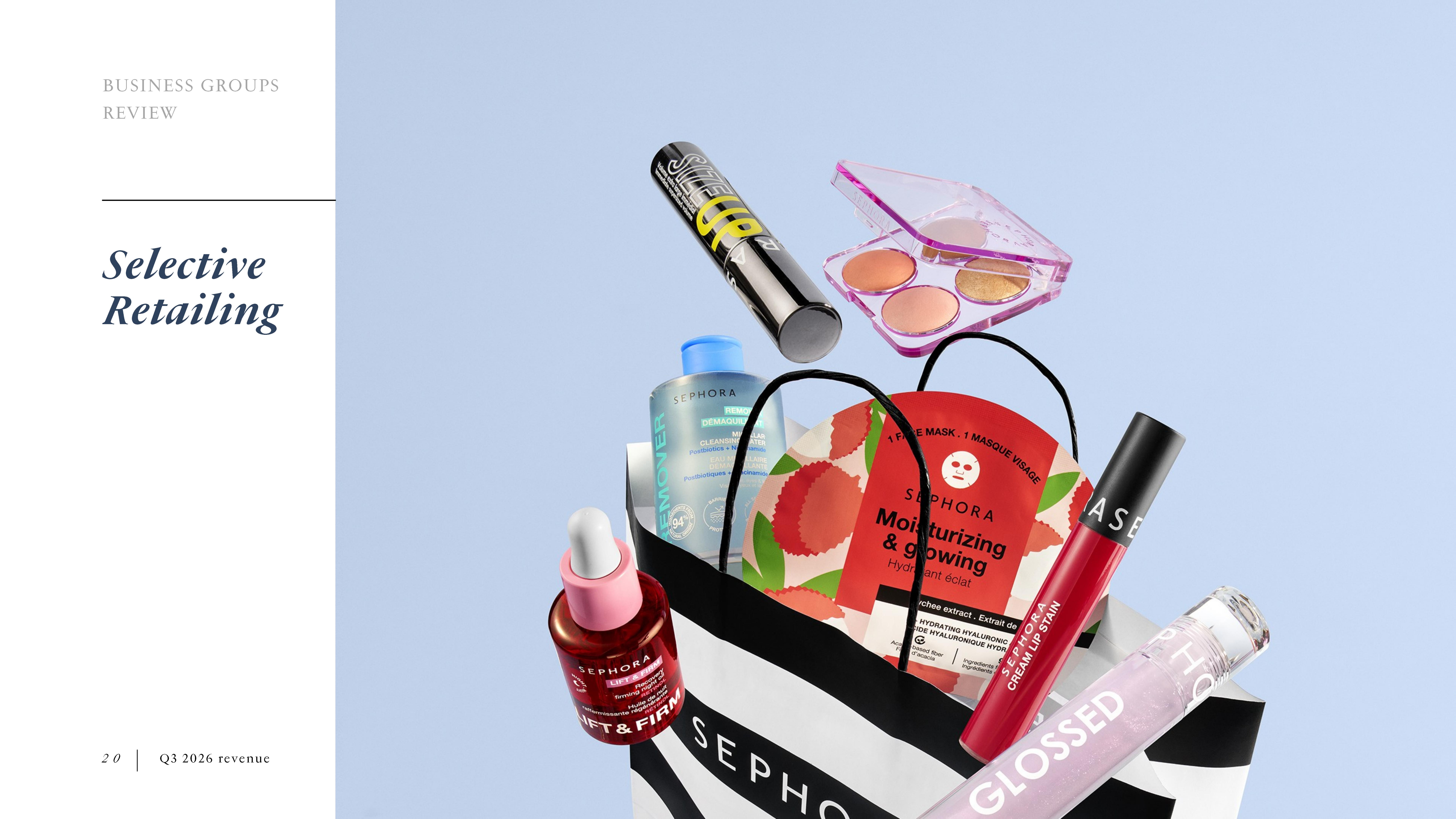
Sephora delivered strong revenue growth, gaining further market share in several countries and consolidating its global leadership position. Growth was supported by its solid brand portfolio, with sustained growth among its many historic brands and continued expansion of exclusive launches, including Rhode and several Chinese beauty (C-Beauty) brands. Its retail network continued to expand, entering Belgium and Croatia and establishing a partnership with local retailer Marks & Spencer in the UK.
Le Bon Marché achieved revenue growth through its distinctive arts and cultural events and introduced a new customer loyalty programme.
Most of DFS’s businesses have been sold. Rodolphe Ozun said on the earnings call that the latest transaction, announced in August, was the sale of DFS’s travel retail business at Zayed International Airport in Abu Dhabi to Falic Group, the parent company of US duty-free retailer Duty Free Americas.
In the first nine months, currency fluctuations had a -3% impact on LVMH’s revenue, while changes in consolidation scope had a -1% impact (from the sale of certain DFS assets and the entire Marc Jacobs business). In the third quarter, the currency impact was +2%, while the impact from changes in consolidation scope was -2%. Group Chief Financial Officer Cécile Cabanis said on the earnings call that currency effects had turned positive after five consecutive quarters of negative impacts.
Looking ahead, LVMH said in its earnings release that, despite continued economic and geopolitical uncertainty, the group remained confident and would pursue a strategy centred on continuously enhancing its brands’ desirability, supported by the authenticity and quality of its products, retail excellence and an agile organisation. LVMH will draw on its powerful brands and the talent of its teams to further strengthen its global leadership in luxury goods in 2026.
In its results presentation, the group outlined four priorities for 2026: Desirability (continued creative renewal and a commitment to the highest quality), Creativity (strengthening iconic products and creating new in-store experiences), Agility (operational efficiency and entrepreneurial spirit), and Excellence (developing craftsmanship and targeted investment).
| Sources: Official financial results, earnings call
| Image Credit: Group website
| Editor: Luxeplace