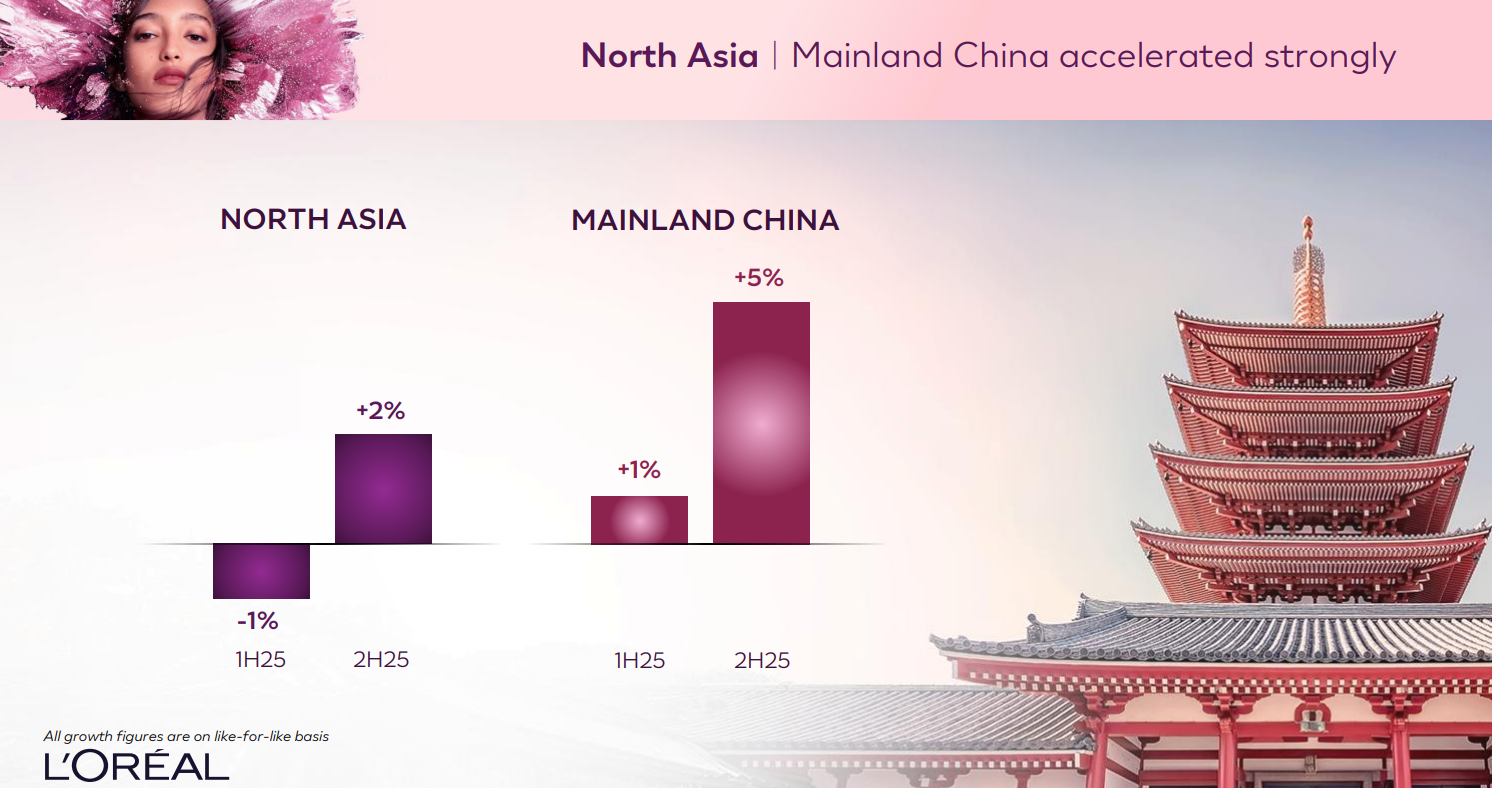
On February 12, French beauty giant L’Oréal Group released its financial results for fiscal year 2025. Fourth-quarter sales reached EUR 11.25 billion, representing a year-on-year increase of 6% on a like-for-like basis and at constant exchange rates, but this growth rate fell short of the widely expected 6.4%. Sales in North Asia, where the Chinese Mainland is located, edged up by 0.6%, also below expectations.
Christophe Babule, Chief Financial Officer of L’Oréal, provided an explanation during the analyst conference call following the earnings release:
“The Chinese Mainland market – our largest single market in North Asia – saw its growth rate rise from 1% in the first half to 5% in the second half, benefiting from a gradual market recovery, particularly in the premium cosmetics segment. However, I understand that, given the positive news coming from Hainan, your expectations for the North Asia market were higher. The reality is that Hainan accounts for only 20% of the overall travel retail ecosystem. In other segments, travel retail in South Korea and the Chinese Mainland has remained weak, with the latter also affected by the temporary suspension of the CDFG duty-free app and changes in domestic airport operators.“
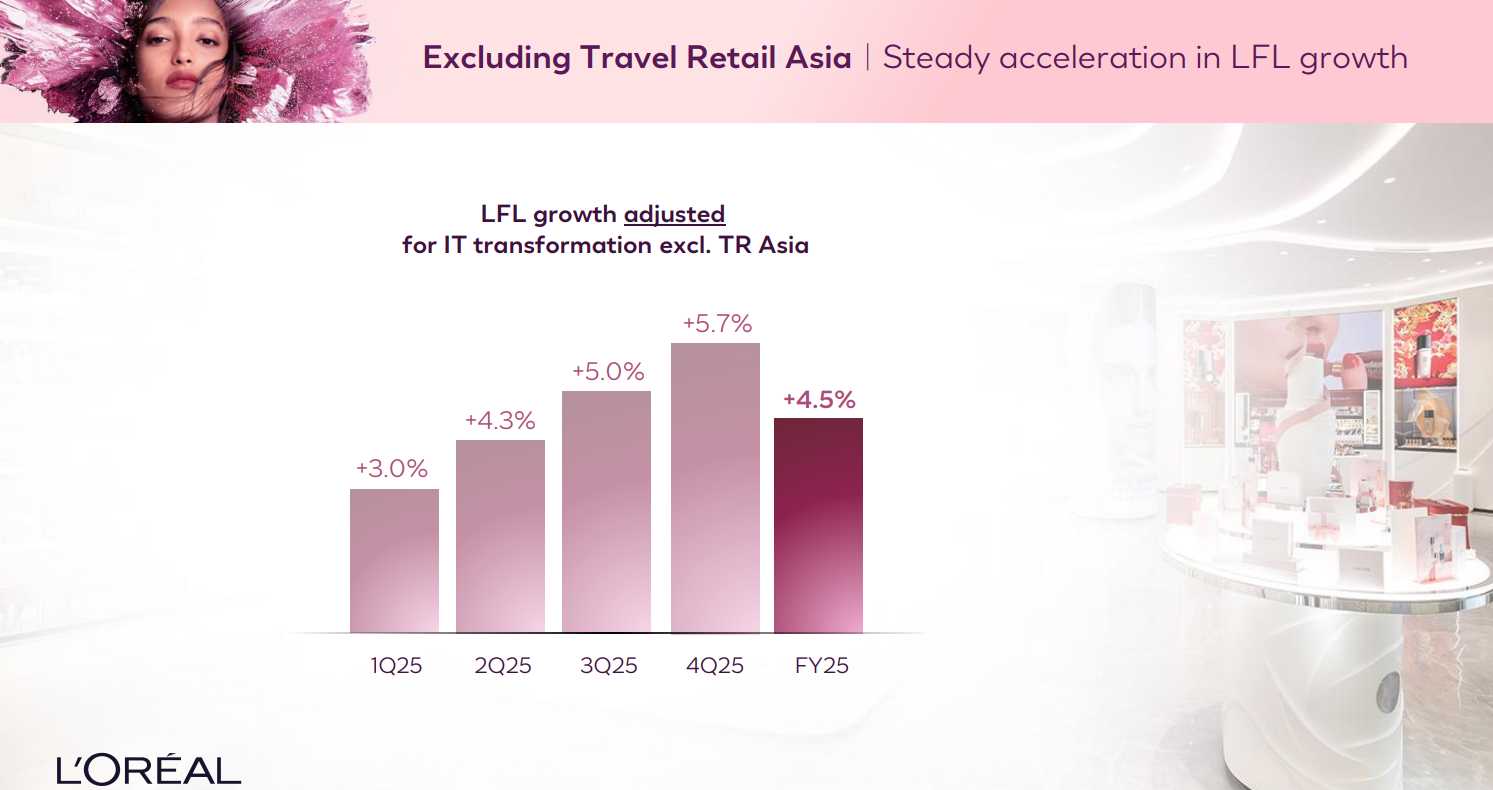
To maintain healthy inventory levels, L’Oréal proactively adjusted its shipment strategy in the fourth quarter. Christophe Babule added: “Sell-out growth gradually accelerated and was close to flat in the fourth quarter, which helped us gain 260 basis points in market share. Currently, Asian travel retail accounts for less than 4% of the Group’s sales, compared with more than 6% three years ago.” Notably, excluding the impact of Asian travel retail, L’Oréal Group’s growth improved by one percentage point quarter after quarter in 2025, demonstrating continued resilience.
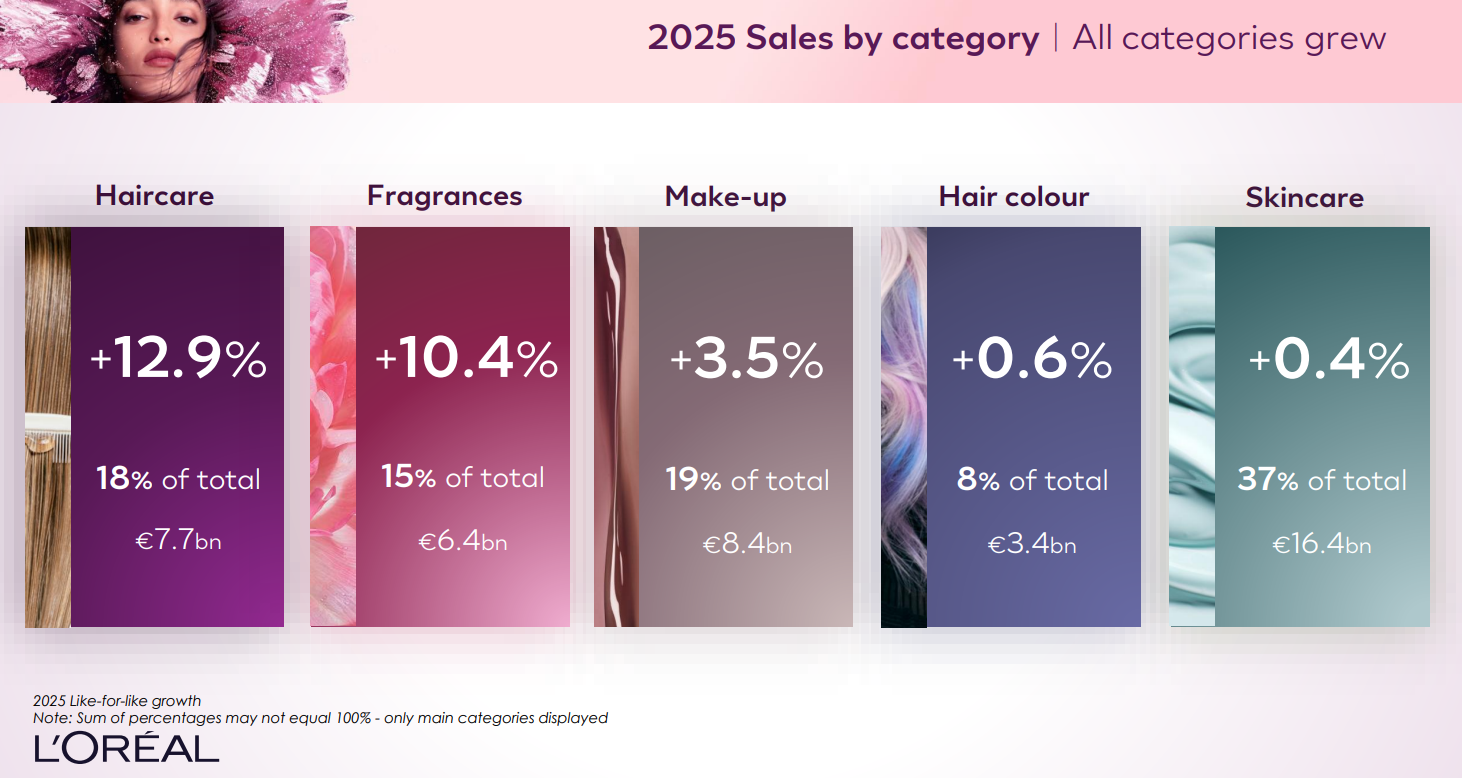
By category, L’Oréal Group’s performance in 2025 showed clear divergence.
Skincare, the Group’s largest category, generated annual sales of EUR 16.4 billion, accounting for 37% of total revenue, but recorded only 0.4% year-on-year growth, essentially flat and below internal expectations. By contrast, the haircare division delivered the strongest performance, with a year-on-year increase of 12.9%.
Nicolas Hieronimus, Chief Executive Officer of L’Oréal, commented, “The skincare category had delivered strong performance for eight consecutive years. The 2025 results did not meet expectations, but it remains our most promising growth segment. With the emergence of many new independent brands, the rules of competition in skincare have changed significantly. As a result, we adjusted our strategy – increasing investment in innovation in the second half and changing our media engagement strategy. Although the skincare category tends to react more slowly, these initiatives are beginning to bear fruit, and sales in the Dermatological Beauty Division have accelerated quarter after quarter.”
Specifically, CeraVe has shown signs of improvement in its core U.S. market; SkinCeuticals has become the third brand within the Dermatological Beauty Division to exceed EUR 1 billion in annual sales; and Vichy achieved strong growth in the second half of 2025.
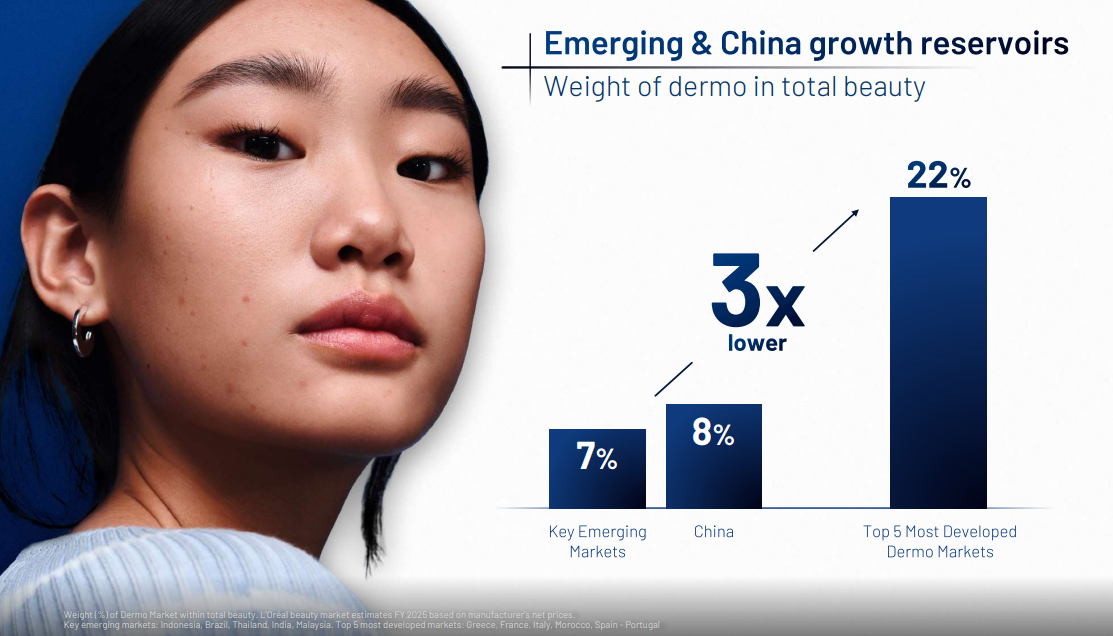
It is worth noting that Myriam Cohen-Welgryn, President of L’Oréal’s Dermatological Beauty Division, stated during the meeting, “China’s potential growth reservoir will bring new consumer groups. In this market, skincare accounts for only one-third of total beauty consumption compared with the most developed countries.”
Nicolas Hieronimus emphasised that the core opportunity for the skincare business lies in longevity science, “As consumers increasingly focus on preventive health and shift their perception of ageing, the concept of longevity is transforming skincare consumption from passive anti-ageing to proactive maintenance of the skin’s health cycle. With more than 15 years of dedicated longevity research, we have a unique advantage and plan to launch beauty supplement products across more brands this year.”
Another major move by L’Oréal Group in the skincare field is increasing its stake in Swiss dermatological beauty company Galderma to 20%. Nicolas Hieronimus commented, “This move will bring us two tangible benefits: first, nominating two L’Oréal representatives to Galderma’s Board of Directors, allowing us to participate deeply in its strategic decision-making while learning from its expertise in aesthetics and the integration of topical products and injectables; second, consolidating Galderma’s profits using the equity method.” In addition, the two parties plan to expand their scientific collaboration and have already launched a research project to measure product performance through imaging technology.
From a channel perspective, e-commerce became a key highlight for L’Oréal Group in 2025.
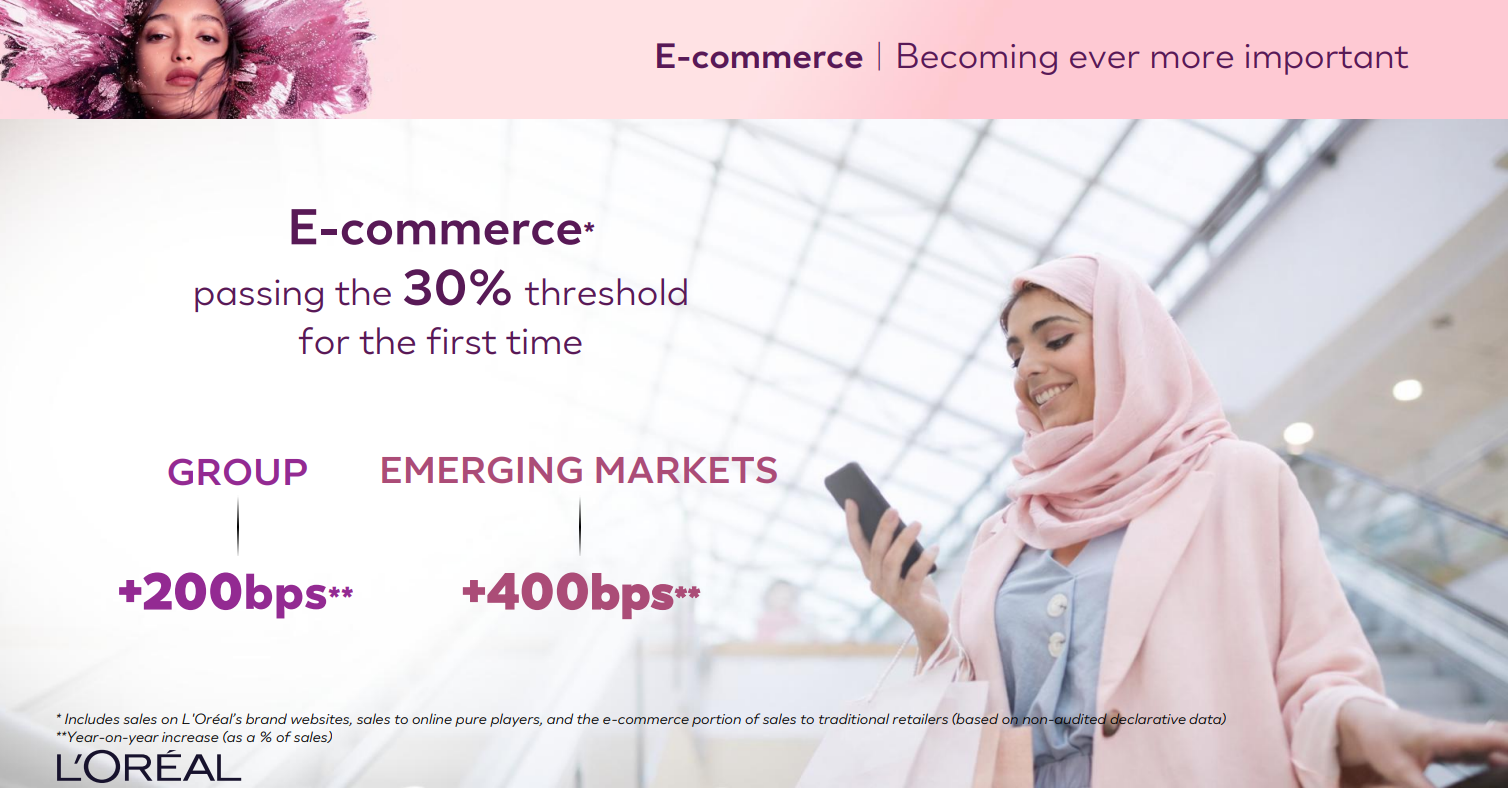
E-commerce sales reached EUR 13 billion in 2025, surpassing 30% of the Group’s total revenue for the first time, up 200 basis points from 2024, and becoming one of the strongest growth drivers. This growth was broad-based across regions, particularly outstanding in emerging markets, where e-commerce penetration increased by 400 basis points in 2025.
Christophe Babule noted: “The global e-commerce market is growing four times faster than brick-and-mortar retail. E-commerce not only enhances margins but also generates strong cash flow. Ten years ago, e-commerce contributed only EUR 1.3 billion in sales, accounting for 5% of our revenue. Today’s performance proves that we are aligned with the winners of growth.”
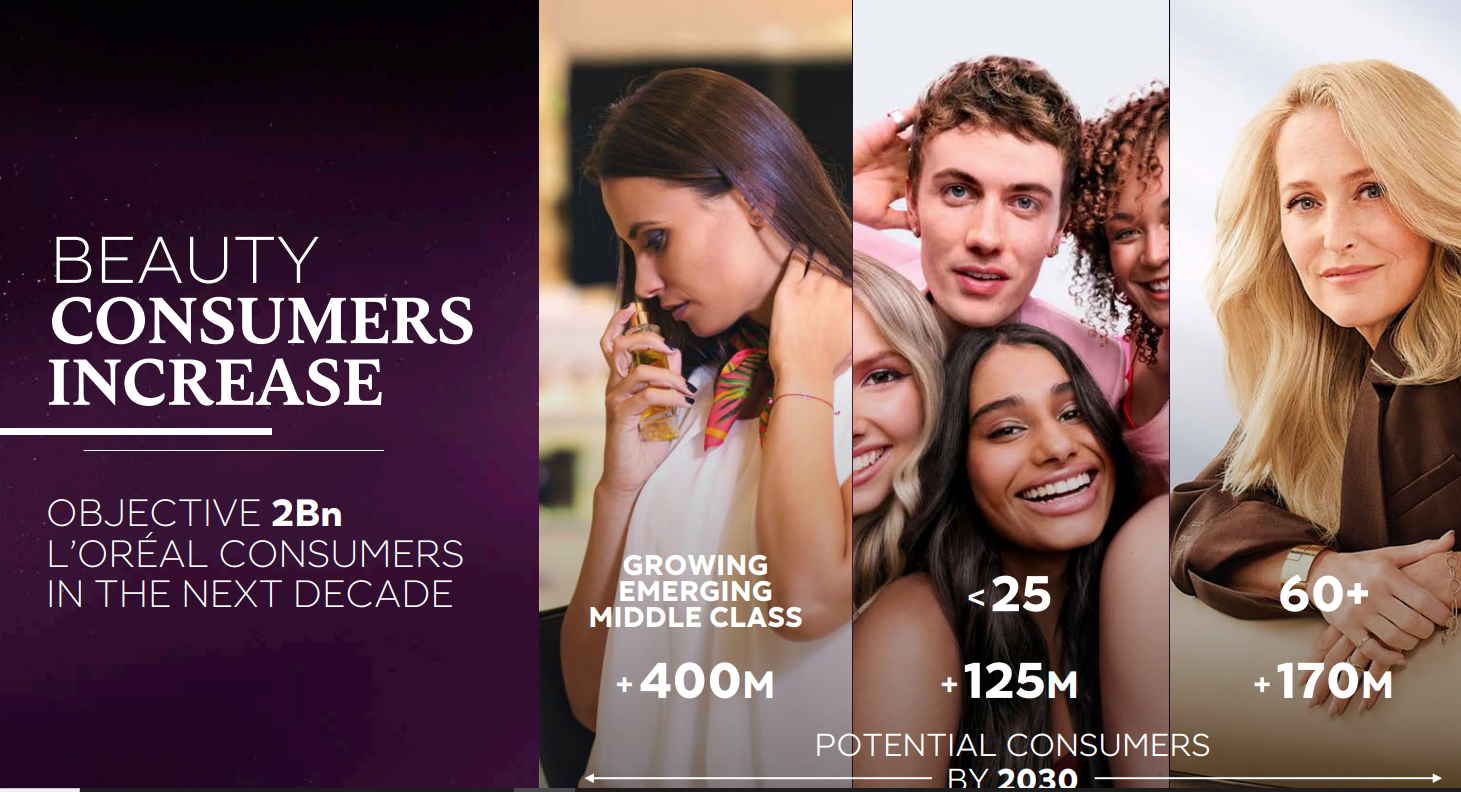
Looking ahead, L’Oréal Group is setting its sights on reaching 2 billion consumers and focusing on four major trends.
Despite short-term challenges in certain markets and categories, Nicolas Hieronimus remains confident about the Group’s future growth: “The transformation in 2025 has made L’Oréal stronger than ever, ready to accelerate growth and push boundaries. The beauty market will benefit from several long-term structural trends, which are highly favourable for us.”
He identified four key trends driving market growth:
- A steady increase in the number of beauty consumers
- The continued expansion of the middle class in emerging markets
- The increasingly younger age at which teenagers enter the beauty category
- Longer product usage cycles among consumers in developed countries due to increased life expectancy
Based on these trends, L’Oréal has set an ambitious goal – reaching 2 billion consumers over the next decade.
丨Source: Analyst conference call transcript
丨Image Credit: Analyst conference call transcript
丨Editor: LeZhi