On October 30, German sportswear brand Puma released its third-quarter 2026 financial results: global revenue fell 5.0% year on year to EUR 1,776.2 million (-6.5% at constant exchange rates), while revenue in Greater China grew 3.5% at constant exchange rates, marking its third consecutive quarter of growth. Meanwhile, the region’s direct-to-consumer business delivered double-digit year-on-year growth.
Currency movements contributed approximately 130 basis points to revenue growth in the third quarter, mainly driven by the US dollar, Mexican peso, Chinese yuan and Argentine peso. The sales decline primarily reflected the distribution optimisation measures initiated in the third quarter of 2025, alongside the continued impact of the ongoing Middle East conflict on consumer demand in Europe, the Middle East, Africa and North America.
Puma CEO Arthur Hoeld said, “Our third-quarter performance was in line with expectations as we continued to move PUMA through this transition year while laying the foundation for future growth. We continued to build momentum in Running, supported by our industry-leading NITRO™ technology. Beyond strong product launches, including the sold-out Another Cotton Lab collaboration, we were inspired by the many personal bests achieved by 300 Project3 participants at the Berlin and Chicago Marathon Majors. The momentum around NITRO™ also continued in track and field, where PUMA athletes won 33 individual medals at the European Athletics Championships in Birmingham and set meeting records at the Diamond League finals.
In Sportstyle, we continued to strengthen our key franchises with new product launches, while the Speedcat remained particularly popular with consumers in Asia.
October marked an important new chapter in PUMA’s history as ANTA Sports became our largest shareholder. We see this as a strong vote of confidence in our strategy, our management team and our future, and we look forward to building a successful partnership together.
We also made important progress on our new brand purpose, rooted in our belief that sport is the greatest force on earth. From next year, it will sharpen our focus and strengthen how we connect with consumers around the world. Together with the actions we are taking across the business, it supports our ambition to take the podium and become a Top 3 Global Sports Brand.
With one quarter remaining in the year, we narrowed our FY 2026 EBIT range and updated our CAPEX outlook based on our current assessment of business performance and the operating environment.”
In the third quarter, Puma’s gross profit margin improved by approximately 420 basis points to 49.5%, supported by lower sourcing costs, including benefits from tariff refunds, an improved channel mix and favourable currency movements. The company reported a loss before interest and taxes (EBIT) of EUR 11.4 million, including EUR 29.8 million in tariff refund benefits and a one-off negative impact of EUR 11.7 million related to its cost-efficiency programme.
Royalty and commission income fell 3.0% to EUR 20.5 million, mainly due to lower royalty income in the US, partly offset by new licensing agreements in other markets.
Inventories declined sharply by 24.3% to EUR 1,608.9 million, primarily due to reduced purchasing volumes.
Free cash flow was positive at EUR 92 million, compared with negative EUR 43 million in the same period of the previous fiscal year, driven by improved working capital, lower tax payments and reduced capital expenditure (CAPEX).
By Distribution Channel
*At constant exchange rates
— Wholesale:
Revenue fell 9.6% year on year to EUR 1,187.9 million, mainly reflecting the deliberate reduction of underperforming business with mass merchants, alongside weaker demand from retail partners in EMEA and the Americas. Wholesale performed more strongly in Asia-Pacific.
— Direct-to-Consumer (DTC):
Revenue rose 1.2% year on year to EUR 588.3 million. E-commerce revenue grew 7.8% year on year, fully offsetting a 2.3% decline in company-operated stores.
E-commerce sales grew despite reduced promotional activity, supported by strong performances in running and HYROX fitness products across all regions, strong demand for football products in Europe, and an expanded presence on e-commerce platforms in Asia-Pacific. The decline in company-operated store sales was concentrated in North America, primarily reflecting lower footfall. DTC’s share of revenue increased to 33.1%.
By Regional Market
*At constant exchange rates
— EMEA (Europe, the Middle East and Africa):
Sales fell 12.0% year on year to EUR 801.2 million. The region’s DTC business grew slightly, while wholesale remained under pressure from the elimination of underperforming business and subdued European demand amid spillover effects from the Middle East conflict.
— Americas:
Sales fell 8.1% year on year to EUR 580.4 million. Revenue in North America declined 17.2%, mainly due to weaker consumer demand and the reduction of underperforming orders from mass merchants. Latin America grew 1.4%, supported by relatively resilient demand in key markets and a recovery in Mexican sales following temporary operational disruption caused by the implementation of strategic initiatives in the second quarter of 2026.
— Asia-Pacific:
Sales grew 10.0% year on year to EUR 394.6 million, supported by sustained strong demand for low-profile sneakers, particularly the Speedcat range.
Sales in Asia-Pacific excluding Greater China rose 13.0% year on year, supported by strong regional wholesale performance, continued momentum in low-profile footwear and growth in HYROX products.
Sales in Greater China grew 3.5% year on year, driven by the local DTC business. E-commerce benefited from expansion across marketplace and social commerce channels, including Dewu and TikTok, alongside new product launches. Wholesale declined as distribution partners became more cautious in placing orders following the announcement of ANTA’s investment. In late October, ANTA Group executives Dennis Tao and Jeanne Huang joined Puma’s Supervisory Board, with Tao becoming its new Chairman.
China is one of Puma’s most important strategic markets. During the quarter, Puma continued to invest in brand experiences, product innovation and retail services, strengthening its brand, product offering and distribution channels in tandem to unlock further growth from its dual focus on “sport” and “fashion”.
For example, PUMA’s first motorsport concept store worldwide is set to open in Shanghai. This represents another “China debut” for PUMA’s retail innovation, while closely connecting the brand’s long-established resources in top-level motorsport with China’s increasingly vibrant motorsport culture. Through this permanent retail space, PUMA will further bring its track-inspired “aesthetics of speed” into urban life, allowing Chinese consumers to experience the brand’s distinctive motorsport culture and pioneering fashion beyond F1 race weeks.
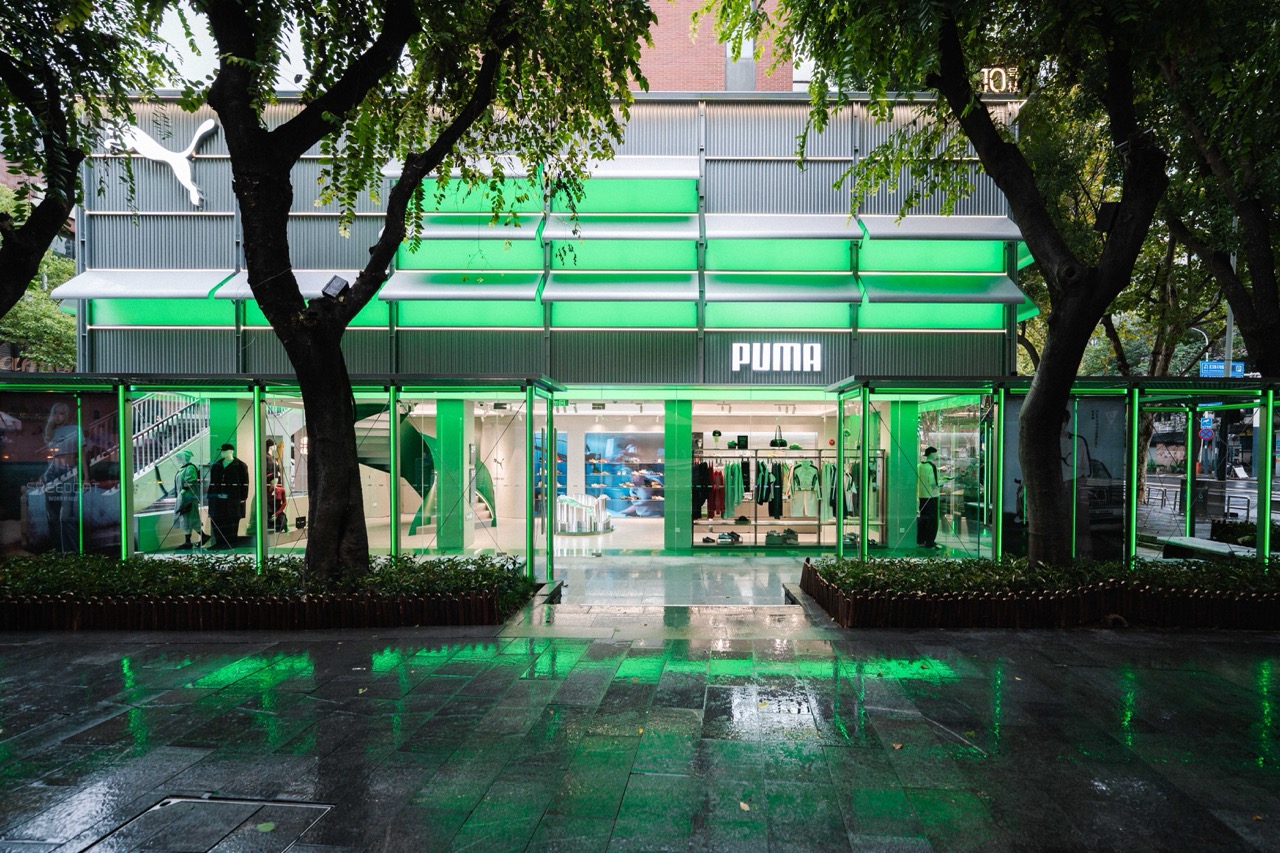
Product innovation and channel premiumisation also reinforced one another, further strengthening the brand’s overall competitiveness in China’s consumer market. During the third quarter, PUMA SNEAKER BOX PLUS stores opened at landmarks in Chengdu and Wuhan, expanding the brand’s premium retail presence in Southwest and Central China.

By Product Category
*At constant exchange rates
— Footwear: Sales fell 5.1% year on year to EUR 1,010.9 million
Performance was subdued in core products, football and selected Sportstyle ranges, partly offset by growth in low-profile sneakers and running products featuring NITRO™ technology.
— Apparel: Sales fell 9.4% year on year to EUR 557.1 million
Demand for core products and childrenswear remained weak, while football, training and motorsport ranges grew. Growth in training was primarily driven by HYROX-related products.
— Accessories: Sales fell 3.2% year on year to EUR 208.1 million
The decline was mainly attributable to lower golf sales.
Looking ahead, Puma’s outlook for fiscal 2026 is as follows:
- Currency-adjusted sales are expected to decline by a low- to mid-single-digit percentage (unchanged);
- The EBIT guidance range has been narrowed to a loss of EUR 80 million to EUR 130 million (previously a loss of EUR 50 million to EUR 150 million).
- Capital expenditure is expected to be below EUR 150 million (previously approximately EUR 200 million).
| Source: Official financial report
| Image Credit: Brand’s official website
| Editor: Luxeplace