After the US market closed on September 3, Canadian athletic lifestyle brand lululemon (NASDAQ: LULU) released its financial results for the second quarter of fiscal 2026 ended August 2, 2026: global net revenue decreased 4% year-on-year to US$2.416 billion, or 5% on a constant dollar basis, below analysts’ expectations, while international net revenue increased 4% year-on-year, or 2% on a constant dollar basis. Foreign exchange movements had a positive impact of approximately 1 percentage point on reported net revenue for the quarter.
lululemon Interim Co-CEO and Chief Financial Officer Meghan Frank noted on the earnings call that sales of women’s leggings declined by approximately 20% during the quarter, below the company’s expectations. Several new away-from-body silhouettes were well received, but were not yet sufficient to fully offset the decline in leggings. She said that the company remains committed to the category and continues to hold a market-leading position, although guests are shifting towards looser silhouettes.
Comparable sales decreased 9% year-on-year during the quarter, or 10% on a constant dollar basis. Bloomberg reported that this marked the company’s first decline in the metric since it resumed reporting comparable sales following the pandemic. (Note: Comparable sales include comparable company-operated store and e-commerce net revenue. Comparable company-operated stores have been open for at least 12 full fiscal months, or for at least 12 full fiscal months after being significantly expanded. They exclude stores that have been temporarily relocated for renovations or temporarily closed.)
Within the international business, the Chinese Mainland accounted for 17% of the Group’s total net revenue, compared with 16% in the same period last year. During the quarter, net revenue in the Chinese Mainland increased 4% year-on-year to US$407.1 million, but decreased 2% on a constant dollar basis; comparable sales decreased 2% year-on-year, or 8% on a constant dollar basis, representing a sharp slowdown from the previous quarter (when net revenue in the Chinese Mainland increased 30% year-on-year, or 23% on a constant dollar basis, while comparable sales increased 20% year-on-year, or 13% on a constant dollar basis).
Speaking about the Chinese market, lululemon Interim Co-CEO, President and Chief Commercial Officer André Maestrini said on the earnings call that the brand faced several issues in China that affected brand sentiment and product perception, weighing on traffic and overall sales momentum. The situation began with a spike in negative commentary about the brand across media and social channels from late in the first quarter into the beginning of the second quarter, with weakness seen across both stores and online channels. E-commerce was also affected by Tmall not extending its “618” shopping festival in the same way as last year, while the company did not participate in promotions following the event.
Following the earnings release, lululemon shares plunged 17.38% from the previous trading day to close at US$100.61 per share on September 4, giving the company a latest market capitalisation of US$11.139 billion. Reuters reported that the stock had hit an eight-year low, approaching levels last seen in May 2018.
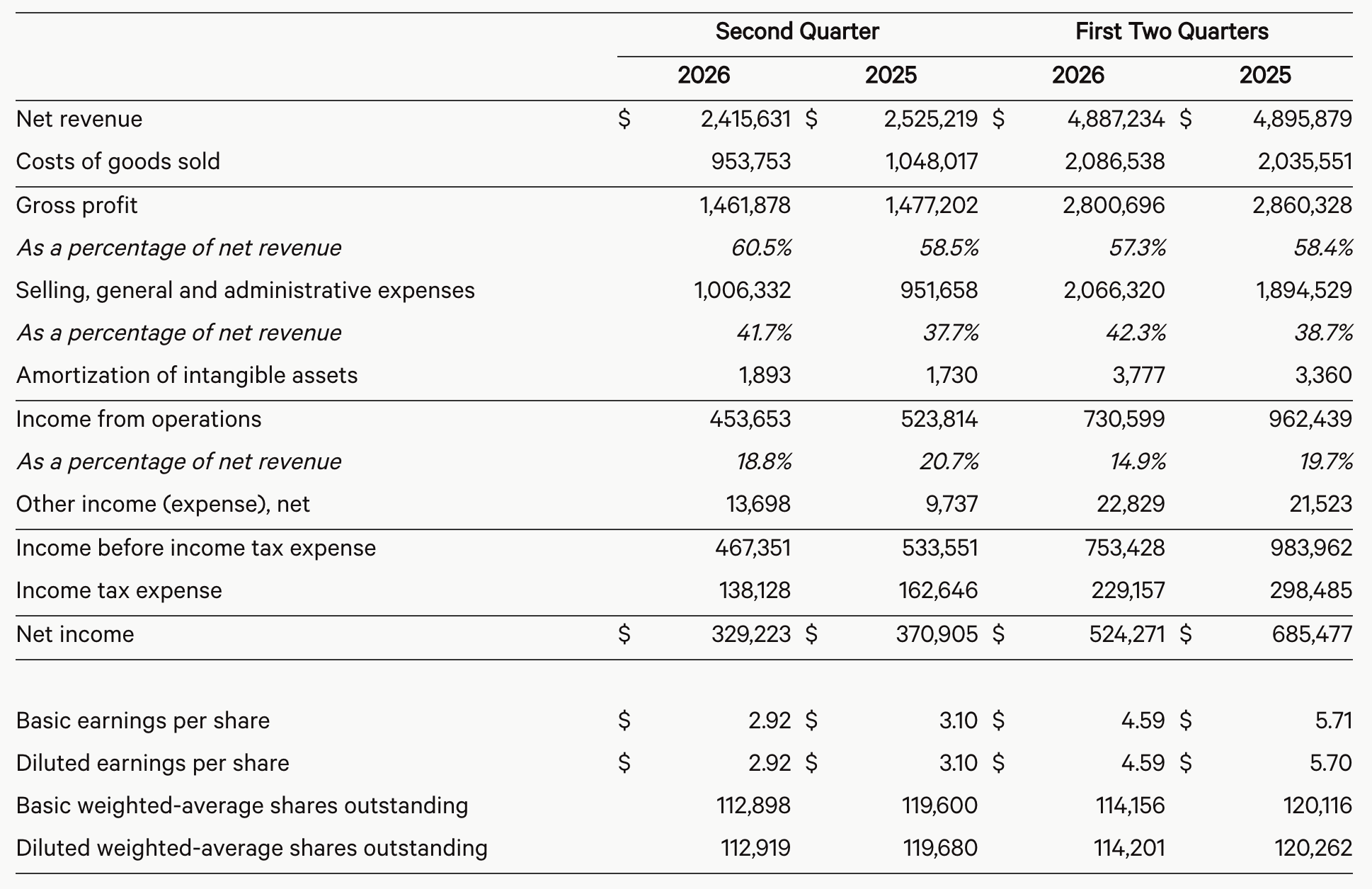
On the profitability front, gross profit decreased 1% year-on-year to US$1.462 billion, while gross margin increased 200 basis points to 60.5% (including US$134.5 million in US tariff refunds, which increased gross margin by 560 basis points); income from operations decreased 13% year-on-year to US$453.7 million, while operating margin decreased 190 basis points to 18.8%; net income decreased 11% year-on-year to US$329 million, while diluted earnings per share were US$2.92, compared with US$3.10 in the same period last year, including a US$0.86 per-share contribution from tariff refunds and associated interest, net of tax.
In terms of stores, lululemon opened nine net new company-operated stores during the quarter (seven in the Americas, one net new store in the Chinese Mainland and one in other international markets), bringing the total store count to 825 at the end of the quarter, compared with 784 in the same period last year. Total square footage increased 11% year-on-year. In addition, lululemon has lowered its fiscal 2026 net new store opening plan from approximately 40 stores, as guided in the previous quarter, to approximately 35, and plans to reduce the number of pop-up stores from 65 at the end of fiscal 2025 to approximately 40 by the end of fiscal 2026.

Meghan Frank said that, “While we continue to navigate some challenging dynamics, we are taking a prudent approach with our revised full-year outlook. Our teams remain focused on accelerating growth by strengthening our product offerings, increasing our marketing investments, and maintaining disciplined expense management. Looking ahead, we have confidence in the strength of the lululemon brand, the deep connection we have with our guests and ambassadors, and the significant opportunities we see to drive long-term growth.”
André Maestrini said, “We remain confident in our ability to take the right steps to strengthen our performance and deliver sustainable growth over time. I would like to thank our teams around the world for their focused efforts and continued commitment to lululemon. We look forward to welcoming our incoming CEO, Heidi O’Neill, next week as we begin an exciting new chapter for the company.”
lululemon’s new Chief Executive Officer Heidi O’Neill (pictured below) will take up the role on September 8. A former Nike executive, she was appointed to the position in April this year. Meghan Frank said on the earnings call that the company expects O’Neill to develop a deep understanding of the business, assess its existing strategies and action plans, and bring a fresh perspective to lululemon’s next phase. Until then, the team’s focus remains on execution.

According to Reuters, several institutions lowered their price targets for lululemon following the earnings release. Morningstar analyst David Swartz expects the company’s pace of store openings to slow and anticipates further cost reductions, management changes and a potential operational “reset”; Laurent Vasilescu, Senior Equity Research Analyst at BNP Paribas, believes that as consumers shift away from the leggings category, the related decline could persist for several quarters or even years.
As of August 2, key financial data for lululemon’s second quarter of fiscal 2026 were as follows:
— By region:
- Americas: Net revenue decreased 8% year-on-year (down 8% on a constant dollar basis), while comparable sales decreased 12% year-on-year (down 12% on a constant dollar basis). Within the region, net revenue in the US decreased 8% year-on-year, while Canada decreased 11% (down 9% on a constant dollar basis).
- Chinese Mainland: Net revenue increased 4% year-on-year (down 2% on a constant dollar basis), while comparable sales decreased 2% year-on-year (down 8% on a constant dollar basis).
- Other international markets (Rest of World): Net revenue increased 5% year-on-year (up 6% on a constant dollar basis), while comparable sales decreased 4% year-on-year (down 3% on a constant dollar basis).
— By category:
- Women’s: Net revenue decreased 4% year-on-year during the quarter.
- Men’s: Net revenue decreased 1% year-on-year during the quarter.
- Accessories and other: Net revenue decreased 13% year-on-year during the quarter.
— By channel:
- Company-operated stores: Net revenue decreased 6% year-on-year during the quarter.
- E-commerce: Net revenue decreased 6% year-on-year during the quarter.
Outlook:
- Third quarter of fiscal 2026: Net revenue is expected to be between US$2.290 billion and US$2.320 billion, representing a year-on-year decline of 10% to 11%; diluted earnings per share are expected to be between US$0.93 and US$0.98. By region, North America is expected to decline by the mid-teens, while the Chinese Mainland and other international markets are expected to grow by 3% to 5%.
- Full fiscal year 2026: Net revenue is expected to be between US$10.350 billion and US$10.500 billion, representing a year-on-year decline of 5% to 7%; diluted earnings per share are expected to be between US$9.48 and US$9.73, compared with US$13.26 in fiscal 2025. By region, North America is expected to decline by the low teens, the Chinese Mainland is expected to grow by the high single digits, and other international markets are expected to grow by the mid-single digits. The company plans to open approximately 35 net new stores and complete approximately 35 store optimisations during the year, with total square footage expected to increase by approximately 10%.
Notably, this marks the second time this year that lululemon has lowered its full-year guidance. Its initial fiscal 2026 guidance issued in March called for net revenue of US$11.35 billion to US$11.50 billion, representing year-on-year growth of 2% to 4%, with full-year net revenue in the Chinese Mainland expected to grow by approximately 20%. In June, the company lowered its full-year net revenue guidance to US$11.0 billion to US$11.15 billion.
丨Sources: lululemon financial results, earnings call, Bloomberg, Reuters
丨Image Credit: lululemon official website
丨Editor: Luxeplace