On July 30, German sportswear giant adidas released its financial results for the second quarter and first half of fiscal year 2026, ending June 30:
The second quarter set a new record for the Group’s highest-ever quarterly net sales, reaching €6.7 billion, up 14% year-on-year; first-half net sales also hit a record high of €13.3 billion, likewise increasing 14% year-on-year.
The second quarter coincided with the FIFA World Cup, during which adidas significantly increased its global marketing investments. Marketing and point-of-sale activation expenses surged 30% year-on-year, rising by €212 million in absolute terms to a total of €924 million. Despite this, operating profit for the second quarter still grew 5% year-on-year to €574 million, with an operating margin of 8.5%, down 0.7 percentage points year-on-year. Net profit rose 6% to €398 million.
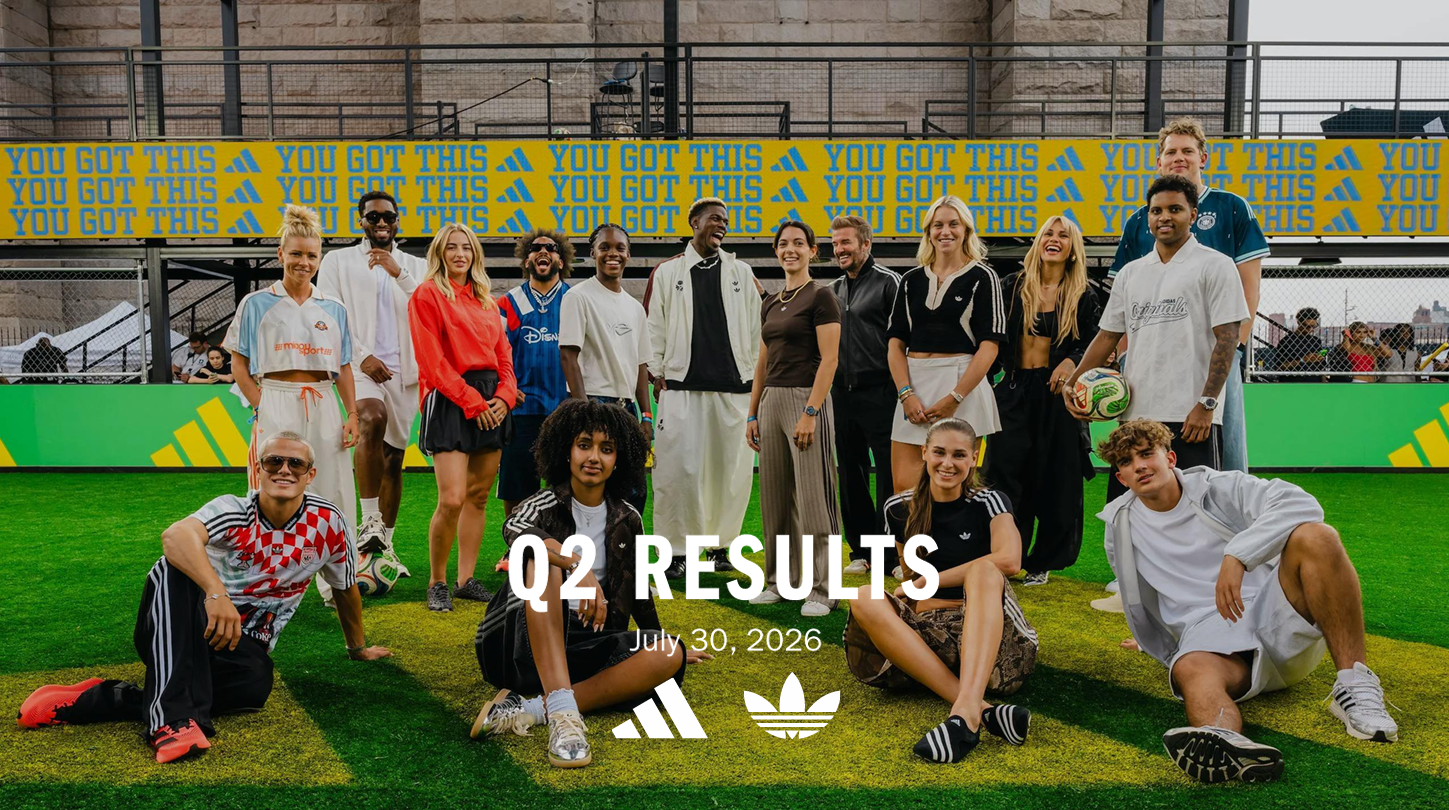
Leveraging the unique platform of the World Cup, adidas strengthened its engagement with global consumers through authentic storytelling, local fan activations, retail experiences, real-time responsive content, and culturally relevant celebrations.
The World Cup campaign “Backyard Legends” generated over 9 billion impressions and more than 400 million interactions across the Group’s digital ecosystem, making it the most successful marketing campaign in the brand’s history. Collaborators included football stars Lionel Messi, Lamine Yamal, and Jude Bellingham, as well as actor Timothée Chalamet and American rapper Bad Bunny.
Other World Cup-related marketing initiatives included football-themed offline activations across multiple markets and “adidas Football Houses” fan zones in various cities, collectively attracting more than 250,000 visitors. Beyond the World Cup, the brand also launched new products such as the Adizero Dropset Elite and Pro running shoes, and unveiled collaborative collections with Rick Owens and Song for the Mute during Paris Fashion Week.
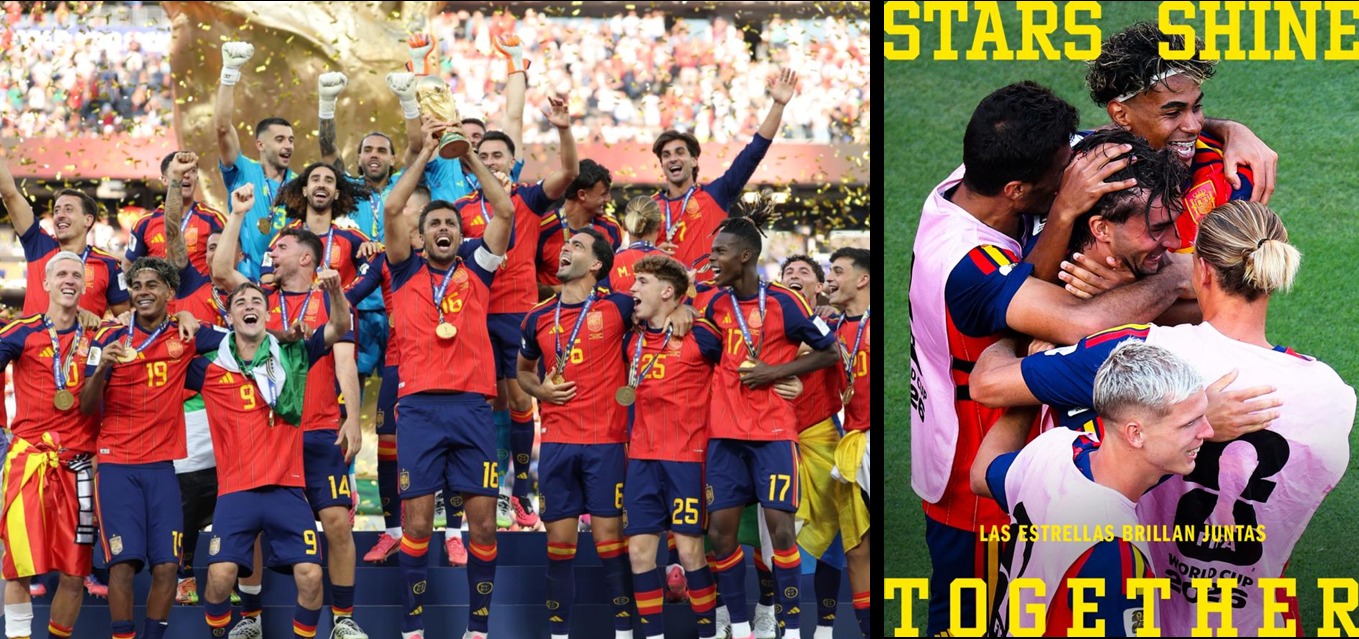
Speaking about the World Cup, adidas CEO Bjørn Gulden said that being CEO of adidas is an honor, and leading the brand during a World Cup cycle makes it even more special. He described this tournament as a “fairy tale” experience and expressed pride in the achievements of the global team, adding that it would be hard to imagine a better outcome.
He noted that the “Backyard Legends” campaign reignited people’s passion for playing football in the streets. Supporting products including jerseys, cultural apparel, running shoes, and official match balls fully embodied what adidas football stands for, with related product sales far exceeding previous levels.
He added that witnessing the two adidas-sponsored teams, Argentina with Lionel Messi and Spain with Lamine Yamal, meet in the final was almost unbelievable. Both teams used the official match ball Trionda, referees wore adidas three-stripe kits for the first time in history, and the brand’s overall presence and performance were “flawless.” He said even founder Adi Dassler would have been proud.

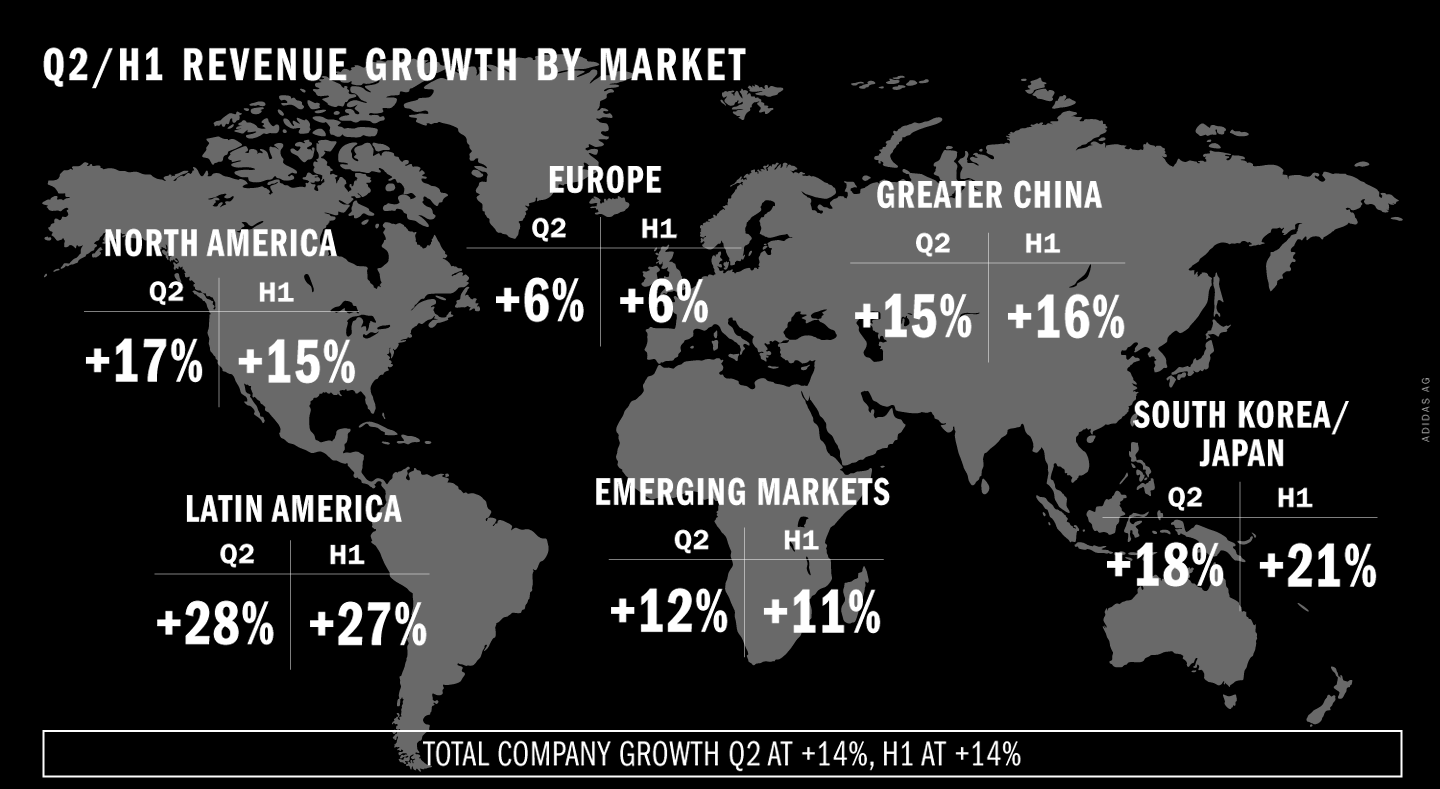
Commenting on the second-quarter and first-half performance, Bjørn Gulden described the results as “unbelievably” strong. Apart from Europe, which grew 6%, all regions delivered double-digit revenue growth, highlighting the brand’s global strength.
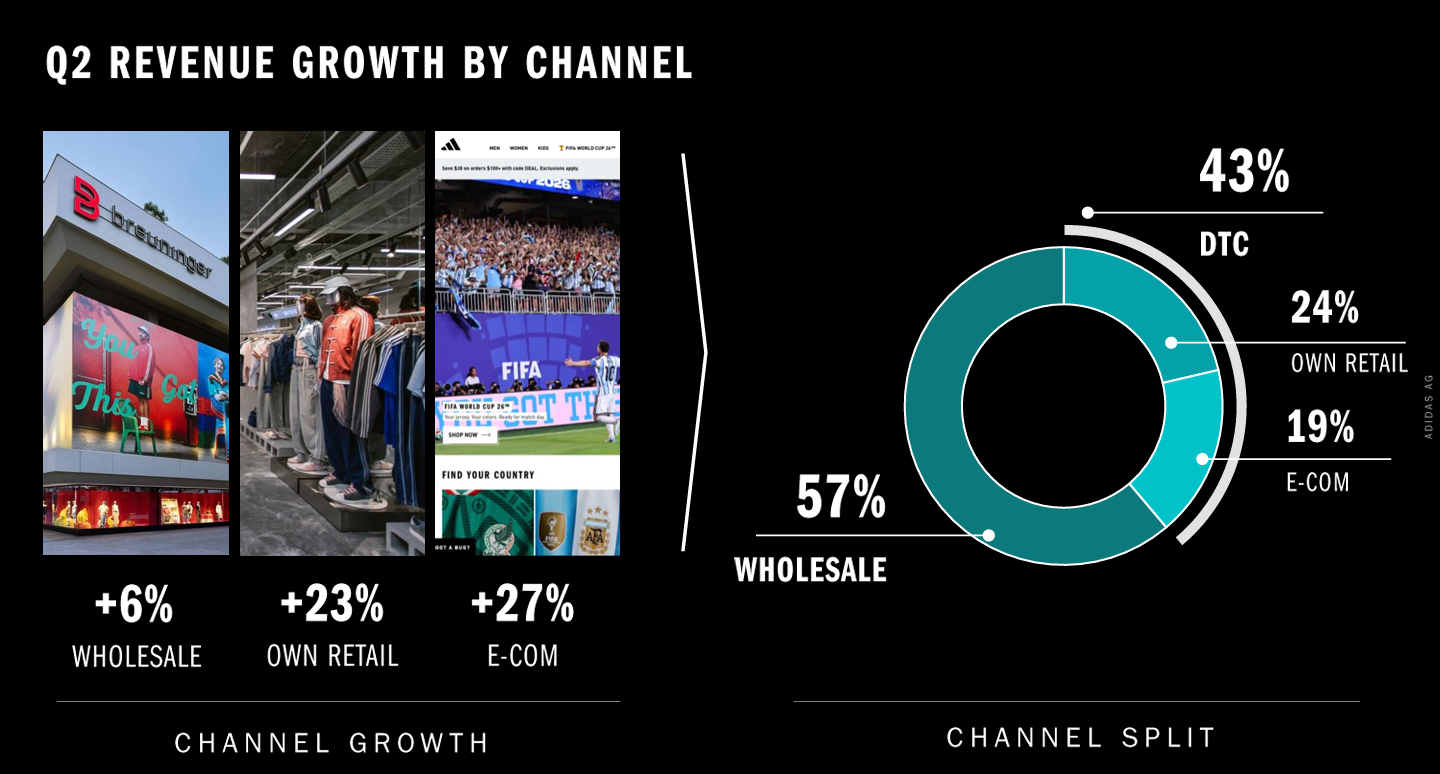
Direct-to-consumer (DTC) revenue rose 25%, achieving double-digit growth across all regions, including Europe. This reflects strong global demand and the effectiveness of tailoring product assortments to local markets. Sell-out continued to outperform sell-in, and many retailers are seeking greater product availability.
Innovation in performance footwear has paid off, with strong growth in football, running, and training categories, offsetting weaker and more challenging conditions in lifestyle footwear. The lifestyle footwear segment, particularly in the men’s market, remains under pressure due to heavy discounting by retailers, especially in Europe and other regions.
Apparel performed exceptionally well, driven by continued innovation in design, fit, materials, prints, and silhouettes within lifestyle apparel, alongside more localized strategies. Many products are designed specifically for local needs and cultural contexts, with some styles sourced locally to enable faster and more flexible in-store updates. Performance apparel also saw strong growth, supported by new products and innovation across football, running, and training categories.
Financial data for adidas’ second quarter of fiscal year 2026 (ending June 30):
— By channel (constant currency)
- Wholesale: revenue increased 6% year-on-year to €3.825 billion;
- DTC: revenue rose 25% year-on-year to €2.909 billion, including a 23% increase in own retail stores and 27% growth in e-commerce.
— By region (constant currency)
- Europe: revenue grew 6% to €2.108 billion;
- North America: revenue rose 17% to €1.522 billion;
- Greater China: revenue increased 15% to €953 million;
- Emerging Markets: revenue rose 12% to €848 million;
- Latin America: revenue increased 28% to €907 million;
- Japan and South Korea: revenue grew 18% to €376 million.
— By category (constant currency)
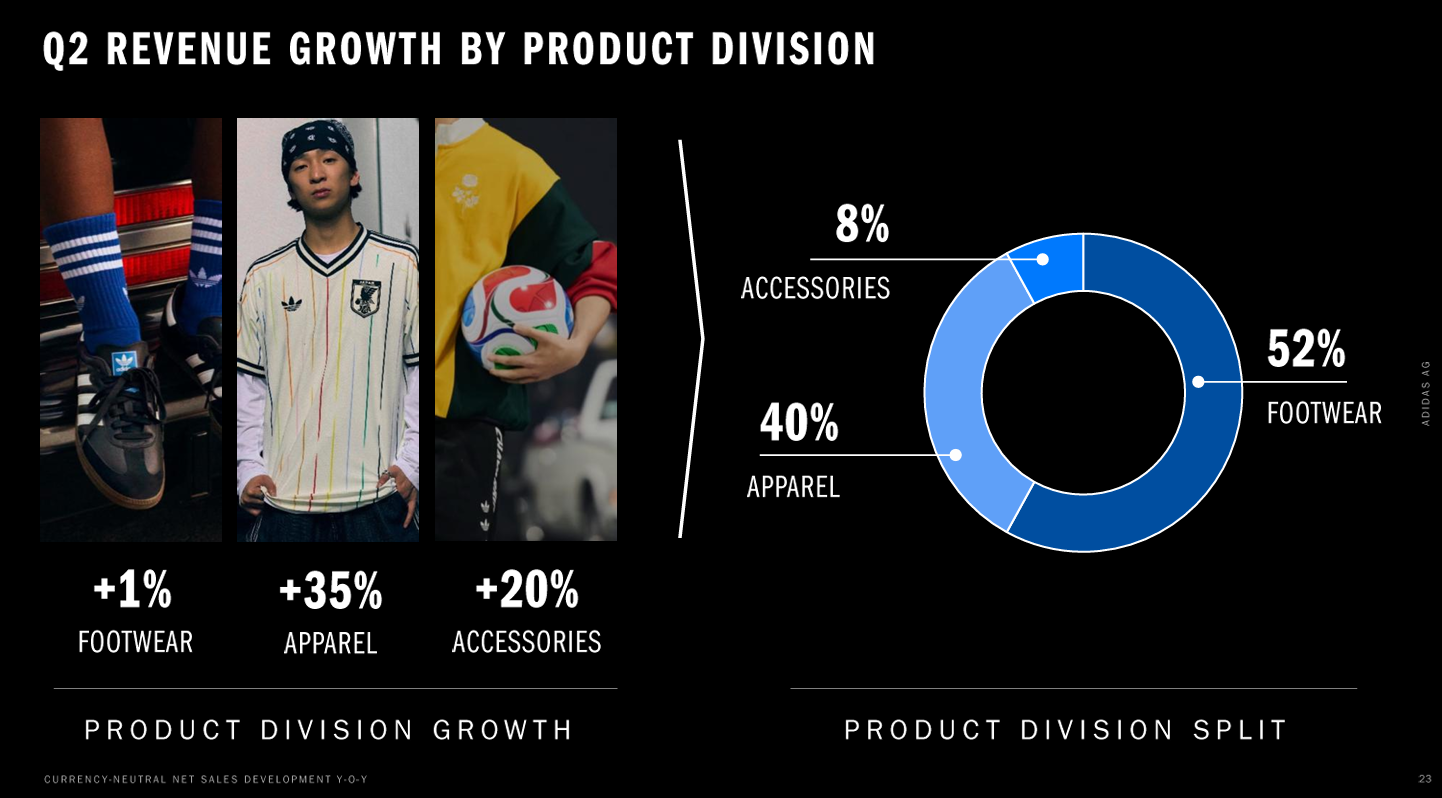
- Footwear: revenue increased 1% year-on-year to €3.492 billion.
Several new professional running shoe models achieved double-digit growth, with particularly strong performance in running and training. Despite strong growth in classic lifestyle running lines, the Group maintained a cautious sell-in strategy to preserve full-price sales amid widespread industry discounting.
- Apparel: revenue surged 35% year-on-year to €2.721 billion.
Football and Originals apparel recorded double-digit growth, while running, training, motorsport, and American sports categories also saw strong gains, reflecting brand momentum across the entire apparel portfolio.
Growth in football apparel was primarily driven by the success of the 2026 FIFA World Cup collection, while Originals growth reflects strong consumer demand for new product lines.
- Accessories: revenue increased 20% year-on-year to €53 million, with multiple subcategories achieving double-digit growth.
— By usage category (constant currency)
- Performance:
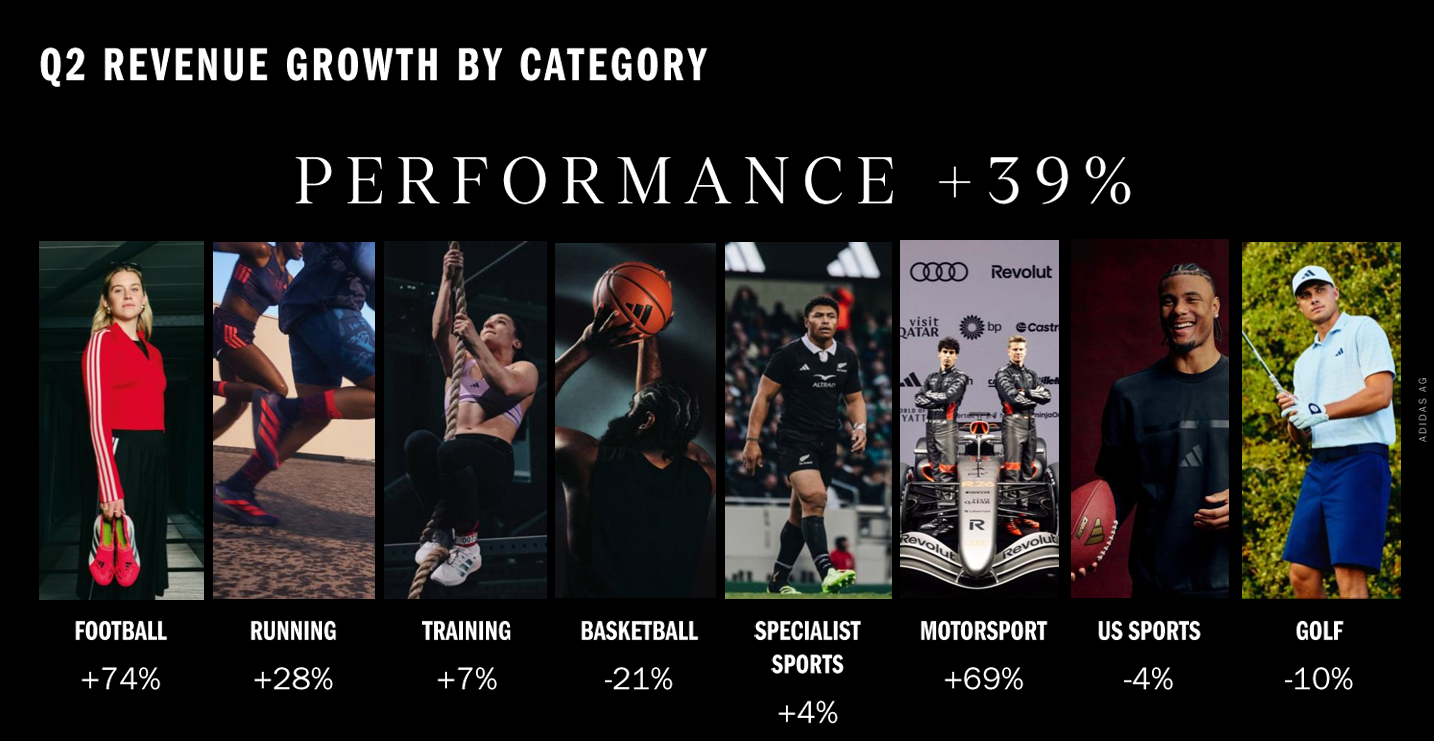
Revenue increased 39% year-on-year, with football (+74%), running (+28%), and motorsport (+69%) delivering double-digit growth, while training (+7%) posted high single-digit growth.
The football category continued to accelerate. adidas launched its most comprehensive World Cup product range ever, including match kits for 14 participating teams, pre-match training apparel, and the official match ball Trionda. The brand also revisited its archives, reintroducing iconic national team jerseys from past tournaments, including the Denim 94 capsule inspired by the 1994 World Cup USA “cowboy” jersey, which became one of the season’s most successful new apparel launches.
In running, signed athlete Sabastian Sawe broke the two-hour barrier at the London Marathon wearing the sub-100g Adizero Adios Pro Evo 3, paired with the innovative 3D cooling Climacool racing vest. The Adizero franchise continues to drive strong demand, with the award-winning Evo SL performing exceptionally well among a broad range of runners, alongside new seasonal and market-exclusive releases. The brand also introduced the first colorways of the Hyperboost Edge, designed for everyday runners seeking comfort and high energy return, and launched a collaboration with Satisfy under the Adizero line, further strengthening its influence within the running community.
In training, adidas reinforced its position in hybrid competition sports through the co-development of Adizero Dropset Elite and Pro products with top hybrid athletes, resonating strongly with fitness enthusiasts worldwide.
- Lifestyle:
Revenue increased 2% year-on-year, mainly driven by double-digit growth in Originals apparel.
adidas extended football culture from the pitch to the streets, with standout collections including the Willy Chavarria x FMF collaboration inspired by Mexican football culture, and the Thrasher x AFA collaboration rooted in Argentine football culture.
| Source: Official financial report
| Image Credit: Official financial report
| Editor: Luxeplace