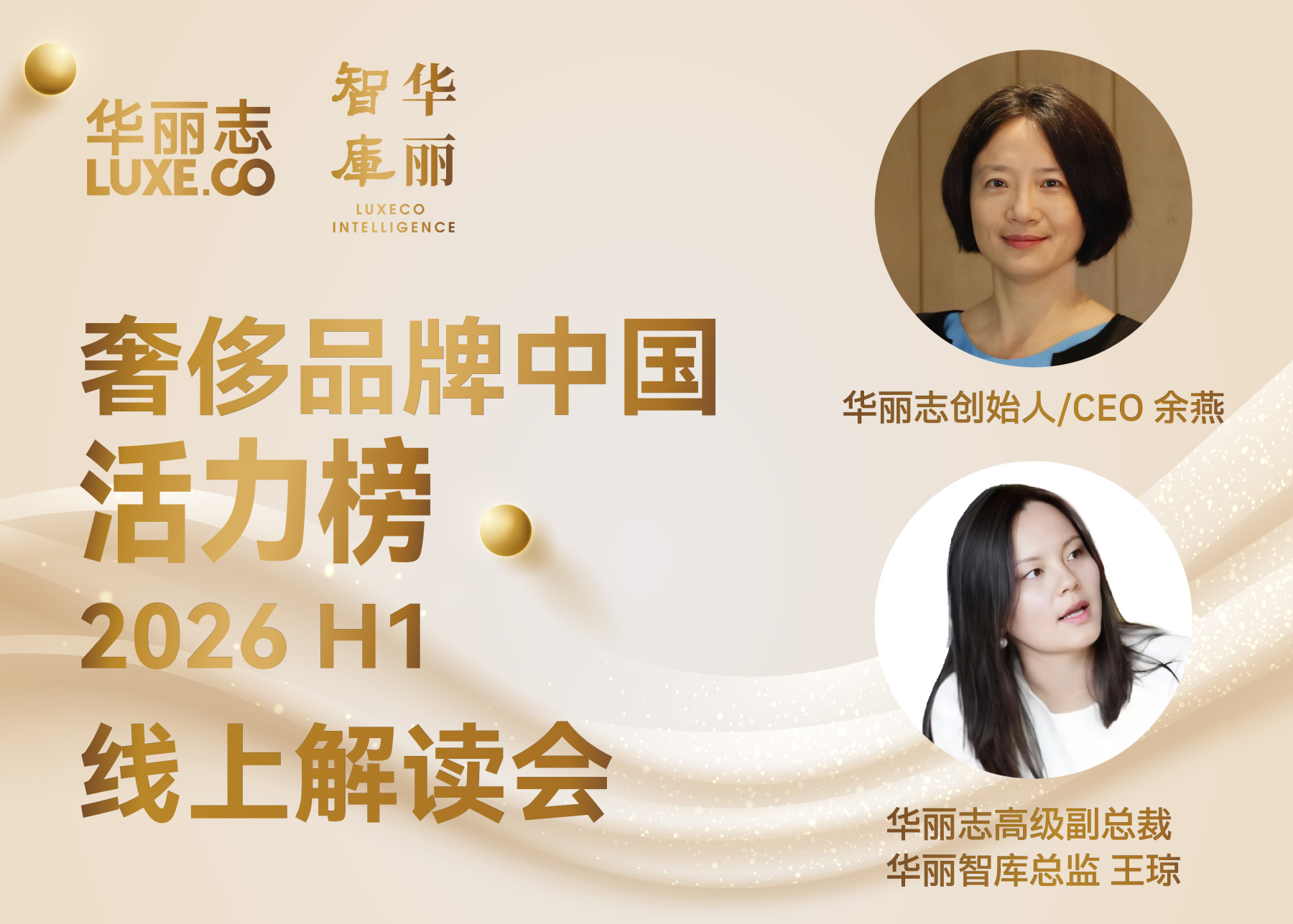
On 7 August 2026, Luxe.CO hosted the online briefing for the “Luxury Brands in China Power Ranking 2026 H1” via video livestream for the first time.
This edition of the ranking covers 249 business developments involving 74 luxury brands in China between 1 January and 30 June 2026, spanning ten categories of marketing and retail expansion activities. For more details on the ranking, see: *Exclusive | Luxe.CO Releases “Luxury Brands in China Power Ranking” 2026 H1*
At the event, Elisa Wang, Senior Vice President of Luxe.CO and Director of LuxeCO Intelligence, provided an in-depth interpretation of the “Luxury Brands in China Power Ranking 2026 H1” report, revealing additional underlying data and exclusive insights. Alicia Yu, Founder and CEO of Luxe.CO, drew on her recent observations and reflections to offer further analysis and commentary on the current state and trends of China’s luxury market.
Changes in the Top 10 of the Luxury Brands in China Power Ranking and the Underlying Logic
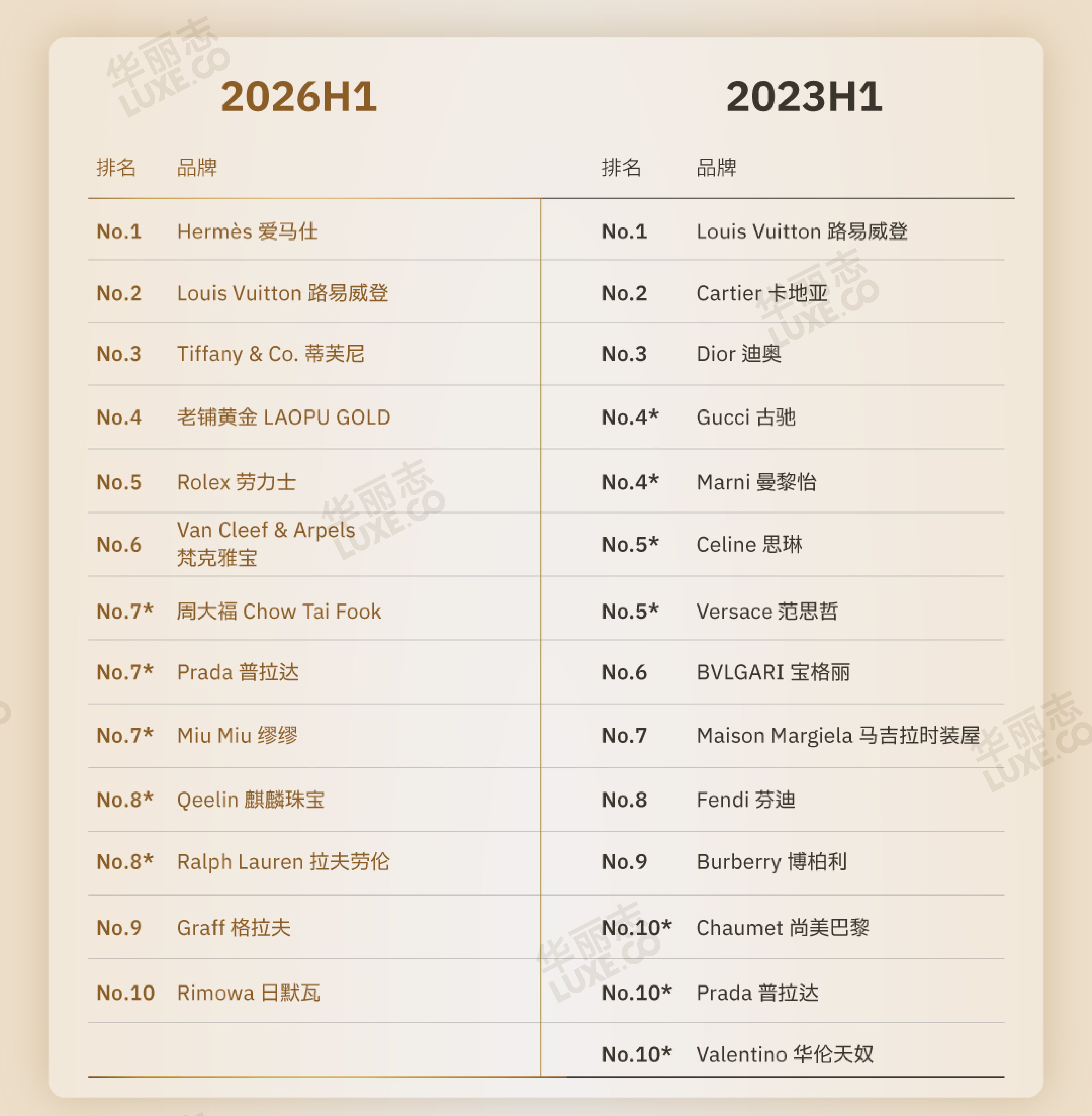
The most notable change in this edition of the ranking is that Hermes took the top spot for the first time, overtaking Louis Vuitton, which had long held the No. 1 position. This shift is closely linked to Hermes’ increased marketing investment in the Chinese market in recent years.
Another notable development is the significant increase in the share of high jewellery and watch brands in the Top 10, emerging as the most distinctive structural feature of this edition. Rolex entered the Top 10 for the first time, as did Graff. Two Chinese brands that have been included in the ranking since the end of 2025, Lao Pu Gold and Chow Tai Fook, ranked fourth and seventh respectively. This marks a sharp contrast with three years ago, in the first half of 2023, when the Top 10 was dominated by “soft luxury” brands in fashion and leather goods. Today, they have been overtaken by “hard luxury” brands in jewellery and watches, particularly high jewellery.
The growing presence of high jewellery brands in the Top 10 is no coincidence. In terms of financial performance, LVMH Group’s results for the first half of 2026 showed that Watches & Jewellery was its strongest-growing business group, with organic growth of 9% in the first half, accelerating to 11% in the second quarter. Richemont’s Jewellery Maisons recorded 24% growth at constant exchange rates in the first quarter of its 2026/27 financial year (April-June 2026), marking seven consecutive quarters of double-digit growth.
At a deeper level, as overall market momentum weakens, the core customer base for hard luxury – high-net-worth consumers – has demonstrated far greater spending resilience than the middle class. Meanwhile, with their stronger investment attributes and broader price ranges, high jewellery brands are well positioned to meet the expectations of consumers across different tiers in their pursuit of “value” and “scarcity” in luxury goods, making the category a stabilising force through market cycles. At the same time, these dynamics are prompting more luxury brands to enter the high jewellery segment and increase their investment.
As Graff’s Global Retail Director said, “In the high jewellery market, both demand and potential are enormous, yet there are still very few top-tier brands.” This may help explain why hard luxury brands are stepping up their investment in the Chinese market even as the broader luxury market cools.
Overall Luxury Brand Activity in the Chinese Market Falls to a Four-Year Low
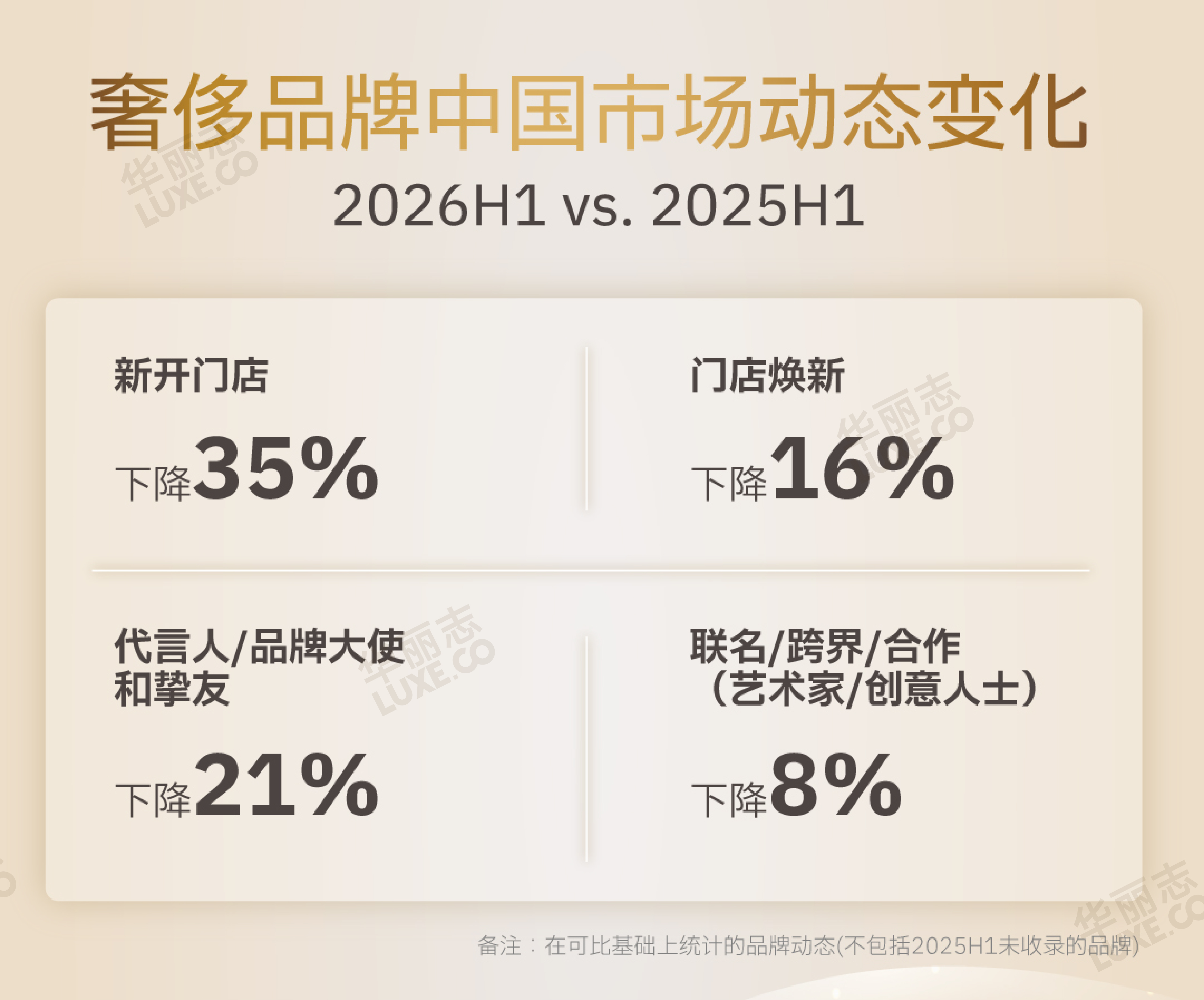
In aggregate terms, overall luxury brand activity in the Chinese market fell to a four-year low in the first half of 2026. The total number of brand developments has continued to decline from its peak in the first half of 2023 – falling by 9%, 34% and 10% year-on-year in the first halves of 2024, 2025 and 2026 respectively.
Across the various categories of activity, new store openings saw the largest decline, followed by appointments of celebrity endorsers and brand ambassadors/friends. Notably, major celebrity endorsement deals are continuing, while lighter-touch partnerships with brand friends or ambassadors declined significantly in the first half of this year.

Store Strategy: From Expansion in “Quantity” to Improvement in “Quality”
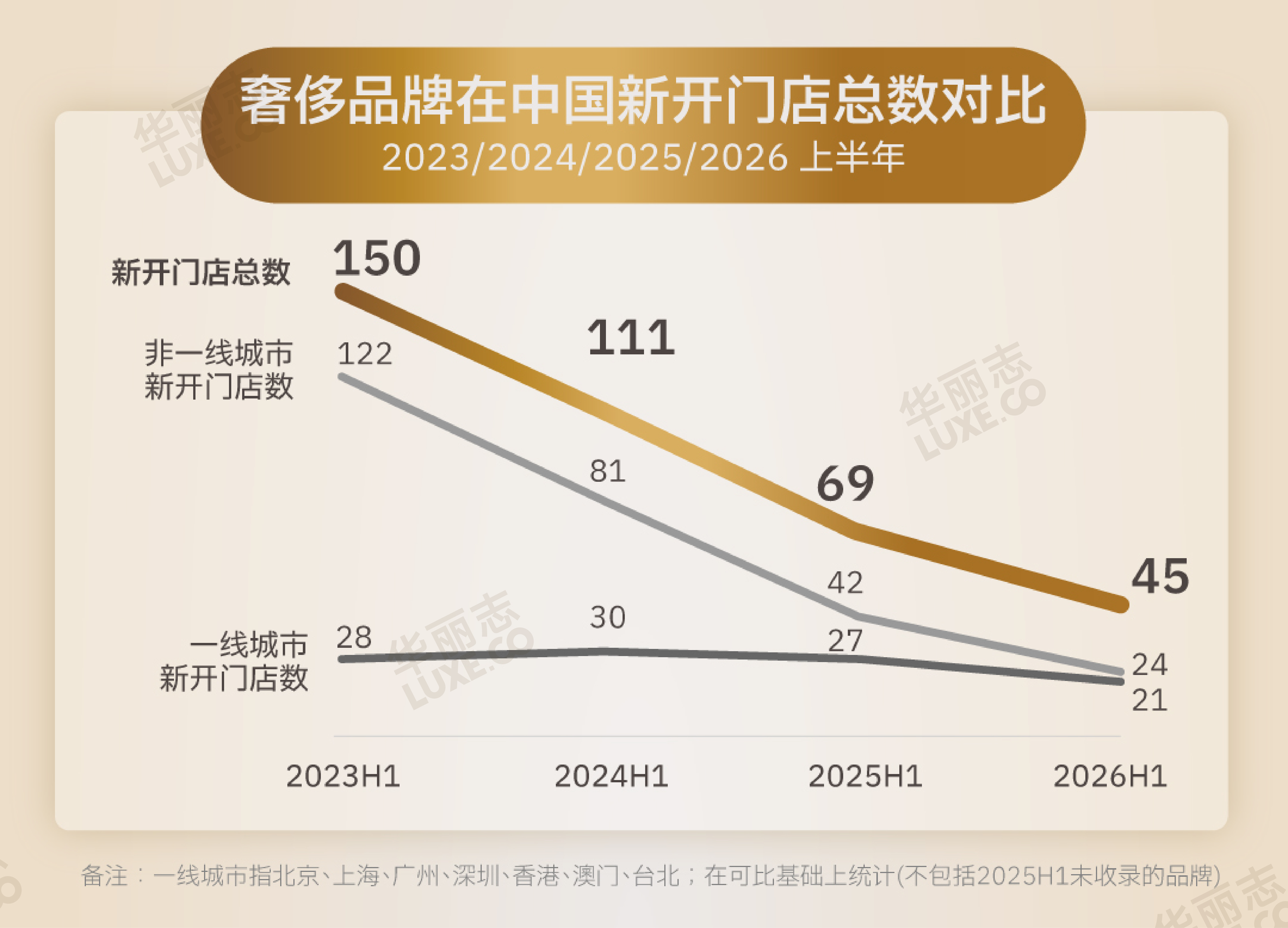
Stores are one of the more heavily weighted dimensions among the ten categories of activity tracked by Luxe.CO’s “Luxury Brands in China Power Ranking”. In the first half of 2026, the brands opening the most new stores were Rolex, Lao Pu Gold and Miu Miu, in that order.
By city, Hangzhou recorded the highest number of new store openings. Here, Hangzhou Tower, the newly opened Hangzhou Centre 66 and Hangzhou MixC have formed a three-way competitive landscape comprising “an established local player + a Hong Kong-backed top-tier luxury destination + a domestic MixC development”. Hong Kong and Macau also ranked among the leading markets, supported by a relatively rapid recovery in demand. Since late 2025, Changchun MixC has progressively welcomed leading international brands, with several luxury brands opening new stores there in the first half of this year.
However, the slowdown in luxury store openings in China is not a temporary phenomenon. Looking back to 2023, the high point when luxury brands opened 14 new stores in China in the final two weeks of the year is now firmly in the past. Yet the slowdown in store openings does not necessarily mean that luxury brands are reducing their investment or level of activity in the Chinese market. With major brands having largely completed their store networks in first-tier cities, the next priority is no longer expansion, but “better locations“, “larger spaces” and “a stronger flagship positioning“.
For example, Prada Group’s CEO has explicitly stated that the Group plans to close two to three stores in China each year over the next two to three years, particularly second or third stores in certain cities. Zegna has also discussed a strategy of store closures and cautious new openings during earnings calls. Optimising store networks to improve efficiency and the service experience could, in turn, have a positive impact on brands’ sales performance.
The Message on the Chinese Market From Listed Luxury Companies’ Financial Results: “Stabilising, but No Strong Rebound Yet”
As major listed luxury companies report their first-half results, Elisa Wang also reviewed and summarised luxury executives’ latest assessments of the Chinese market:
- Hermes CEO: “We have seen the situation in China stabilise, but we have not seen further improvement. Our situation in China is stable, but it has yet to regain its previous momentum.”
- Richemont: Greater China returned to double-digit growth in the first half, with strong demand in Hong Kong and Macau serving as the main driver.
- Kering CFO: “The Chinese Mainland market remains in decline, but has shown a clear sequential improvement. Greater China has improved overall, with Taiwan returning to positive growth while Hong Kong remains slightly weak.”
- LVMH Group CFO: “Demand from both local Chinese consumers and Chinese travellers was broadly flat in the first half. Chinese demand is increasingly concentrated around key shopping occasions, making it necessary to assess trends over a longer timeframe.”
Taken together, these executives’ comments suggest that the prevailing tone for China’s luxury market can be summarised as “stabilising, but no strong rebound yet”. The period of sharp decline has ended, but the inflection point for a return to robust growth has yet to arrive.
Finally, Elisa Wang highlighted two key challenges facing luxury brands in the Chinese market:
The first is the challenge of cultural storytelling. Public attitudes towards luxury culture are evolving. Brands need to rethink how they communicate with Chinese consumers and how, in an increasingly rational consumption environment, they can create brand narratives that are genuinely credible and desirable, rather than relying solely on traffic and exposure.
The second is the challenge of the growth model. With China’s luxury market struggling to deliver a strong rebound, the traditional growth model driven simply by store network expansion and price increases is no longer sustainable. Brands need to make more proactive changes across pricing strategies, product mix, product innovation and customer experience, while improving the granularity and responsiveness of their operations and management. Only then can they defend their positions – or even increase their market share – in the “new normal”.
Coming soon: The full transcript of Luxe.CO Founder and CEO Alicia Yu’s remarks from the livestream will be published shortly. Stay tuned.
| Image Credit: Luxe.CO
| Editor: Elisa