The World Gold Council recently released its report, 2026 Chinese jewellery retailer insights: Confidence check.
The report revealed that China’s gold jewellery demand has remained under pressure throughout 2026. Weighed down by subdued consumer confidence and elevated gold prices, gold jewellery demand by weight fell 30% year on year to 136 tonnes in the first half of 2026, its lowest first-half level since 2006.
Although consumers are buying lighter pieces, their interest in gold jewellery has not waned. Spending on gold jewellery rose 5% year on year in the first half to RMB144 billion (approximately USD21.6 billion), the second-highest first-half total on record.
Meanwhile, China’s gold demand is showing a clear divergence. In 2025, gold investment demand exceeded jewellery consumption for the first time in history, a trend that continued into 2026. Gold purchases for investment in China reached 342 tonnes in the first half, far outstripping the 136 tonnes consumed as gold jewellery.

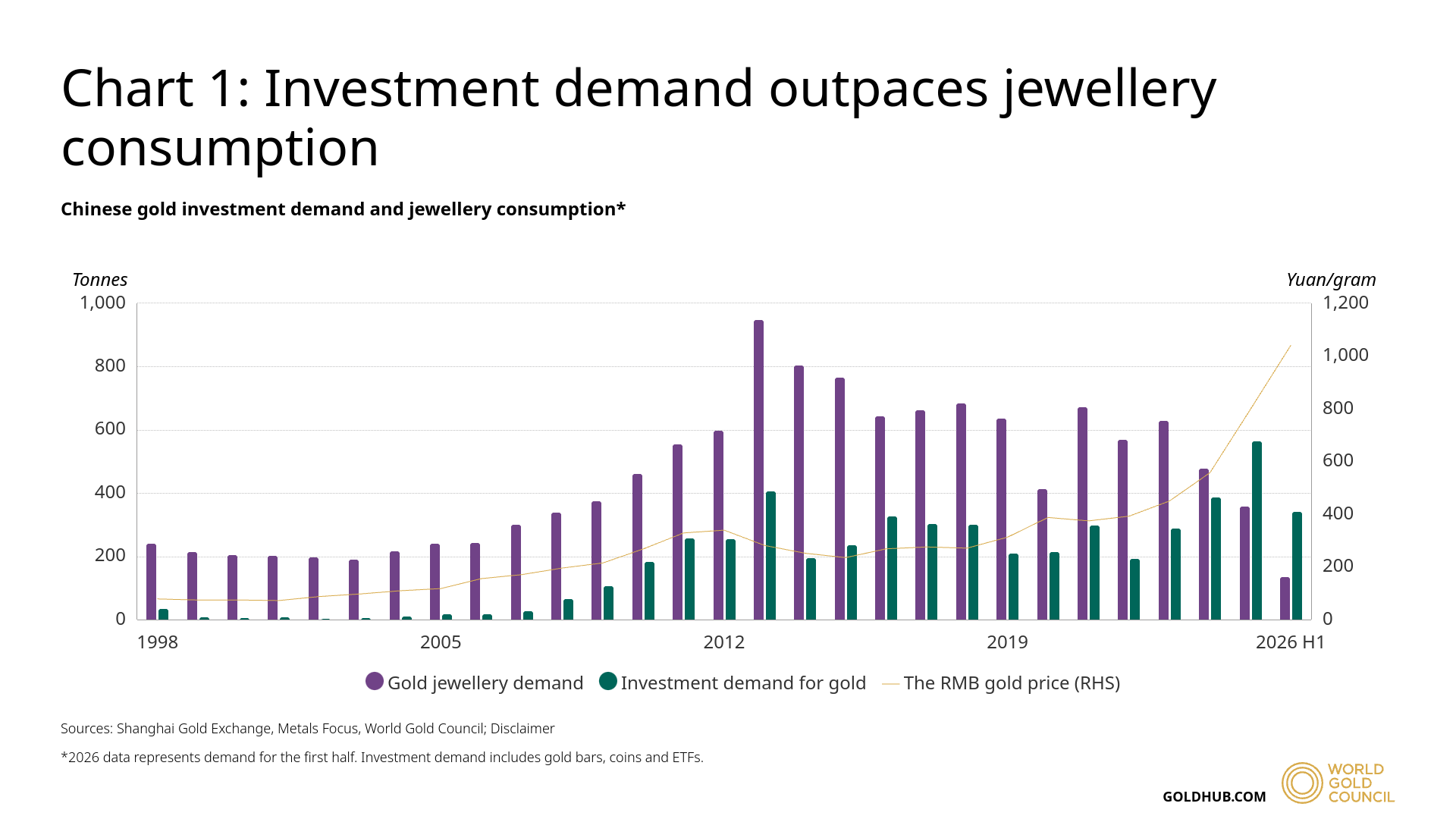
Above: Gold investment demand and jewellery consumption from 1998 to the first half of 2026
The report noted that China is shifting from a property-driven economy to a technology-led one. Against a backdrop of slowing economic growth and persistent weakness in the property market, investors are increasingly turning to gold as a store of value and a means of diversifying their portfolios, supporting investment demand while demand for gold jewellery suffers.
For the seventh consecutive year, the World Gold Council partnered with China Gold News to conduct a new round of research among Chinese jewellery retailers. Through online questionnaires and in-person interviews, the survey gathered feedback from 744 store managers and regional heads at major jewellery brands across China. Half of all respondents were from tier-four markets and below, while 15% were from tier-one cities.
The findings showed that gold jewellery remains one of the most important revenue sources for Chinese retailers. However, rising gold prices, compounded by costs passed on following VAT reform, have led to a sharp contraction in gold bar sales.
Among gold jewellery categories, Heritage gold and Hard Pure gold proved the most resilient, outperforming other categories for the fourth consecutive year. 15% of retailers reported higher first-half sales of Heritage gold than in 2025, while 12% reported revenue growth in Hard Pure gold. The corresponding figures for mainstream designs and 18K and 22K gold were 9% and 4%, respectively.
Field research showed that small, lightweight pieces featuring fashionable designs or strong cultural elements have become a revenue mainstay for jewellers. Despite rising costs, consumers continue to favour 24K gold, gravitating towards products that combine affordability, design appeal and gold’s ability to retain value.

Percentage of all surveyed retailers reporting year-on-year sales growth in each gold jewellery category in the first half of 2026
The survey showed that buying for oneself remains the primary driver of gold jewellery consumption in China. Some 44% of respondents said their customers bought gold jewellery to treat themselves, up from 27% in 2024 and 37% in 2025. By contrast, traditional occasions such as weddings accounted for just 17%, down from 24% in 2024 and 19% in 2025. Gifts between couples, gifts for family members and gifts for children accounted for 16%, 12% and 11%, respectively.
The report suggested that this profound shift may be the most important structural change in China’s gold jewellery market. It marks a transition from purchases driven by traditional occasions to those driven by emotion, with gold jewellery increasingly viewed as a discretionary lifestyle category whose role extends beyond ceremonial occasions.

Percentage of retailers identifying each purchase motivation as a key source of revenue in the first half of 2026
By age, consumers aged 18-34 remain a core pillar of gold jewellery consumption, while Hard Pure gold buyers are younger on average than the overall gold jewellery customer base.
Meanwhile, retailers are reducing their gold inventories. Slower turnover and higher financing costs resulting from elevated gold prices have prompted many retailers to close stores, postpone expansion and scale back operations. 45% of respondents plan to reduce their gold product inventories, and the proportion planning to cut stock has exceeded the share planning to increase it for the third consecutive year. Meanwhile, 43% of retailers intend to maintain their current gold inventories, while 12% plan to increase them.
The narrow gap between the proportions choosing “no change” and “destocking” falls well short of what would be expected in a deep industry downturn. The report interpreted this as a sign that the industry is undergoing a period of cautious adjustment rather than a full-scale retreat.
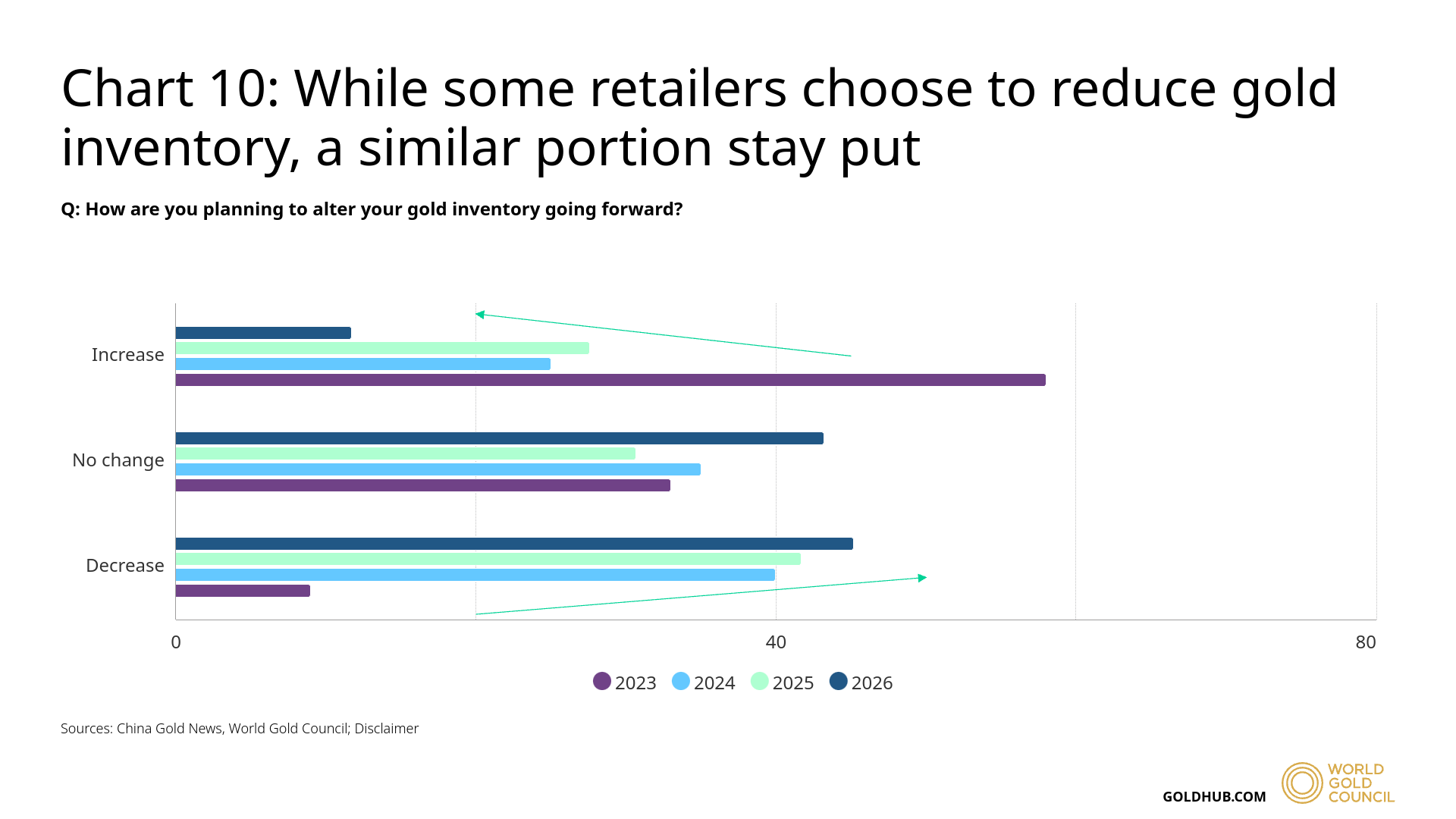
Percentage of retailers planning to increase, maintain or reduce their gold inventories
Looking ahead, more than one-third of retailers still believe sales of gold products could recover, the highest proportion across all jewellery categories, although lower than in last year’s survey. Silver jewellery ranked second in terms of optimism.
More than 60% of respondents believe that, faced with this unusually sharp rise in gold prices, many consumers have simply postponed their purchases rather than abandoned them altogether. They expect this demand to return once consumers adjust their price expectations and become accustomed to current gold prices.
Retailers continue to adjust their product strategies in response to high gold prices and macroeconomic pressures, with affordability remaining a priority. More than 40% of respondents plan to increase the share of products weighing less than 5g, while 47% intend to expand their 5-10g ranges. Overall, the proportion of retailers focusing on products below 10g has risen markedly from 60% in 2025. The industry’s shift towards lighter products continues, evolving from a short-term response into a structural product strategy.
| Source: Original report
| Image Credit: Original report
| Editor: Luxeplace