“We’ve once again achieved double-digit growth, and our profitability in China is also improving. So, we are very, very pleased with the current trajectory of our business in China.“
During a recent earnings call, Adidas global CEO Bjørn Gulden (pictured below) opened his remarks by highlighting the strong and somewhat unexpected performance in the Chinese market. In Q3 2025, despite ongoing uncertainty in the overall market environment, Adidas brand revenue in the Greater China region rose 10% year-on-year at constant currency, with a 12% increase year-on-year for the first three quarters.
This result was no accident. Based on the latest call transcript, Luxe.CO observed that the Adidas leadership team is undergoing a sweeping localization transformation in the Chinese Mainland—revamping its competitive logic from design and supply chain to a precise push into lower-tier markets. A number of key data points and insights were disclosed, such as “50% to 60% of apparel sold in China is designed and developed locally,” “expansion of the €80–100 product line in China,” and “plans to open more stores in tier-3 to tier-5 cities.”

When pressed by analysts to explain what is driving the growth in China, product or distribution, Bjørn Gulden revealed Adidas’s core secret to success in the market: comprehensive localized empowerment.
Gulden laid out the logic behind this strategic transformation in detail:
“Our strategy in China, of course, is to compete not only with successful local brands but also with Western brands. We quickly realized that to do this, you need more local initiatives and need to leverage the advantage of having factories in this market. That way, you can bring products to market faster and operate with actually less inventory.”
“That’s why we established the Shanghai Creation Center. We built a Chinese management team—people who had worked for Adidas in the past, then went to work for other brands and learned how local brands operate, and then came back to us.”
This strategy led to a fundamental change in product composition. Adidas no longer attempts to simply import popular Western products into the Chinese market; instead, it empowers its local team to design for Chinese consumers.
Gulden disclosed the current level of localization:
“Among the products we sell in China, especially apparel, 50% to 60% is designed and developed in China. So these are not products that are designed and developed for the U.S. or Europe. In footwear, most of the styles come from our global range, but there might be material adjustments. In addition, there are specific product categories designed exclusively for China, including in lifestyle, Originals, and especially Performance.”
While discussing global supply chain and sourcing strategy, Gulden presented a slide showing the geographical distribution and division of product development (image below—blue represents global development, purple represents localized development, and green shows development at the production source). He emphasized the unique advantages of China as a production base:
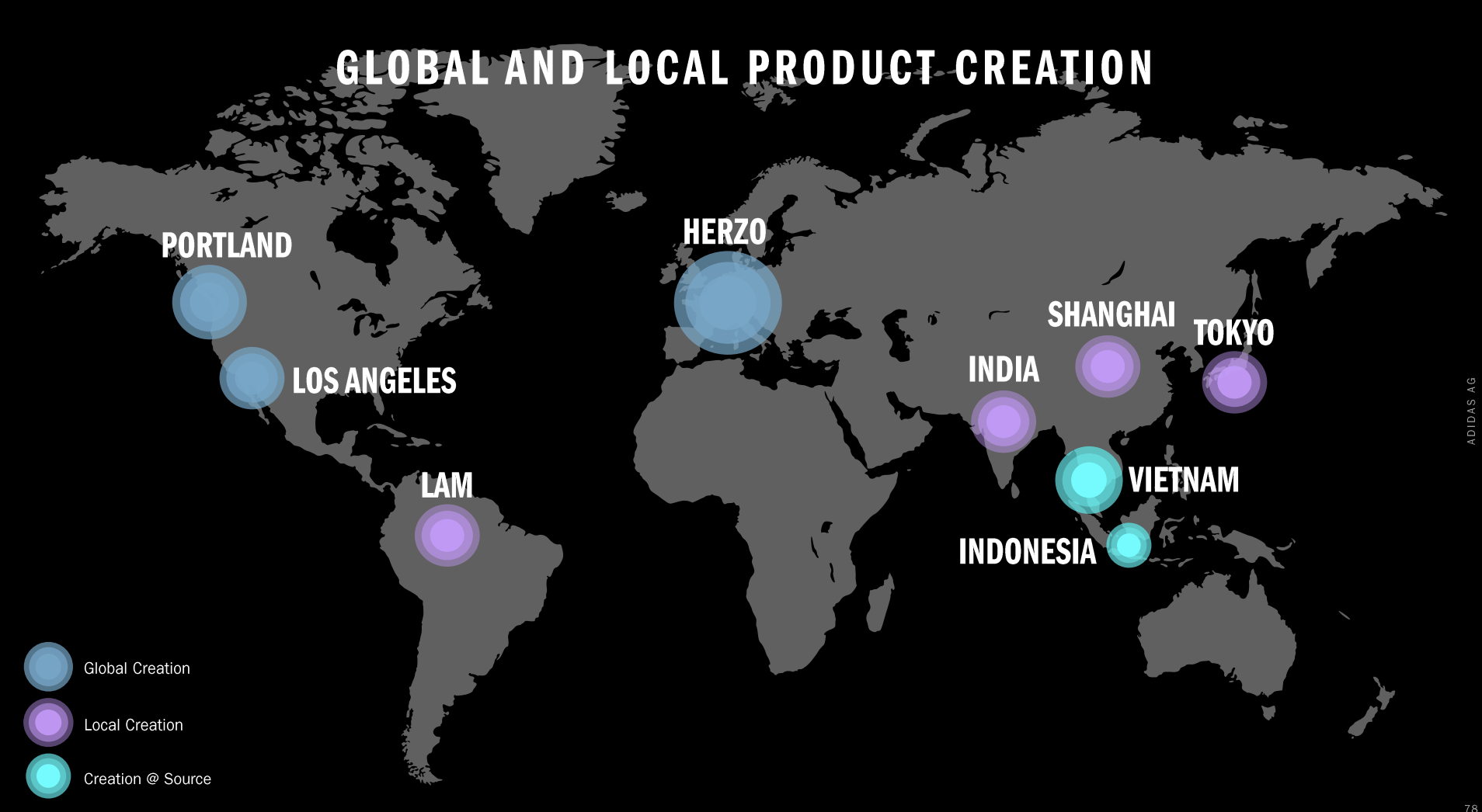
“When it comes to product development, I think this slide is also very important for you to see. We are now developing products in all of these centers. In addition to undertaking part of the global development work (for example, Los Angeles handles basketball and U.S. sports), these centers also have a sharper focus: to provide what local consumers want. This applies to all of them. As you can see, we now have five such local development centers in Asia. Combined with production capabilities in China or India, the speed to market in these local markets is, of course, much faster than in Europe or the U.S., where production is limited and it’s actually very difficult to find supply chains capable of making footwear.”
In addition to localizing product design, Adidas has also adjusted its channel and pricing strategies. Gulden explained how the company is entering the €80–100 price band through specific product lines and opening stores in tier-3 to tier-5 cities:
“We saw that local brands had introduced many high-quality products in the €80 to €100 range, and we lacked competitiveness in that price segment. So, we used our designers, developers, and factories to create competitive products for this segment. And in those tier-3, tier-4, and tier-5 cities where local brands dominate, we’ve already started opening stores focused on what I call ‘value products,’ offering special deals for them.”

Gulden also stressed how organizational restructuring and decentralization have contributed to their performance, particularly through devolving decision-making power to regional markets:
“I believe that when you look at our double-digit growth and our profit margins, our success is due to our shift toward localization and giving power to very, very talented people. I must also say, the energy, especially from our Latin America team and our China team, these might be the two most energized teams in any market. They’re really out there chasing the business, going where the consumers are. I think that’s the reason for our success. And frankly, I think it’s the only way to succeed in the future. I don’t think you can sit in the U.S. or Europe, design a collection, and then tell other markets to sell it. I think that model no longer works.“
“I don’t know what other brands or consumer goods companies are telling you. But to be a global brand with a local mindset, I believe, is absolutely critical. If you are truly consumer-centric—and in our case, athlete-centric—you have to be close to the consumer. Unfortunately, the kind of global average consumer that many consultants and agencies try to sell you simply doesn’t exist. Consumers in different parts of the world have their own tastes and preferences and are influenced by different factors.“
“That’s why becoming more localized is increasingly important—especially across China-driven Asia, the Americas, and Europe. The differences are not just in consumer taste and sports culture, but also, given all the current geopolitical tensions, in supply chains as well,” Gulden concluded.

|Source: Earnings call
|Image Credit: Official website
|Editor: LeZhi