For globally recognised luxury brands, flagship stores are evolving from sales outlets into spaces for brand experiences and long-term customer engagement.
The Luxe.CO Luxury Brands China Vitality Ranking 2026 H1 (the “Vitality Ranking”) shows that luxury brands’ overall activity in the Chinese market in the first half of 2026 was at its lowest level in nearly four years. At the same time, brands are changing their store strategies in China, shifting their focus from expanding their networks to improving individual store performance and the customer experience.
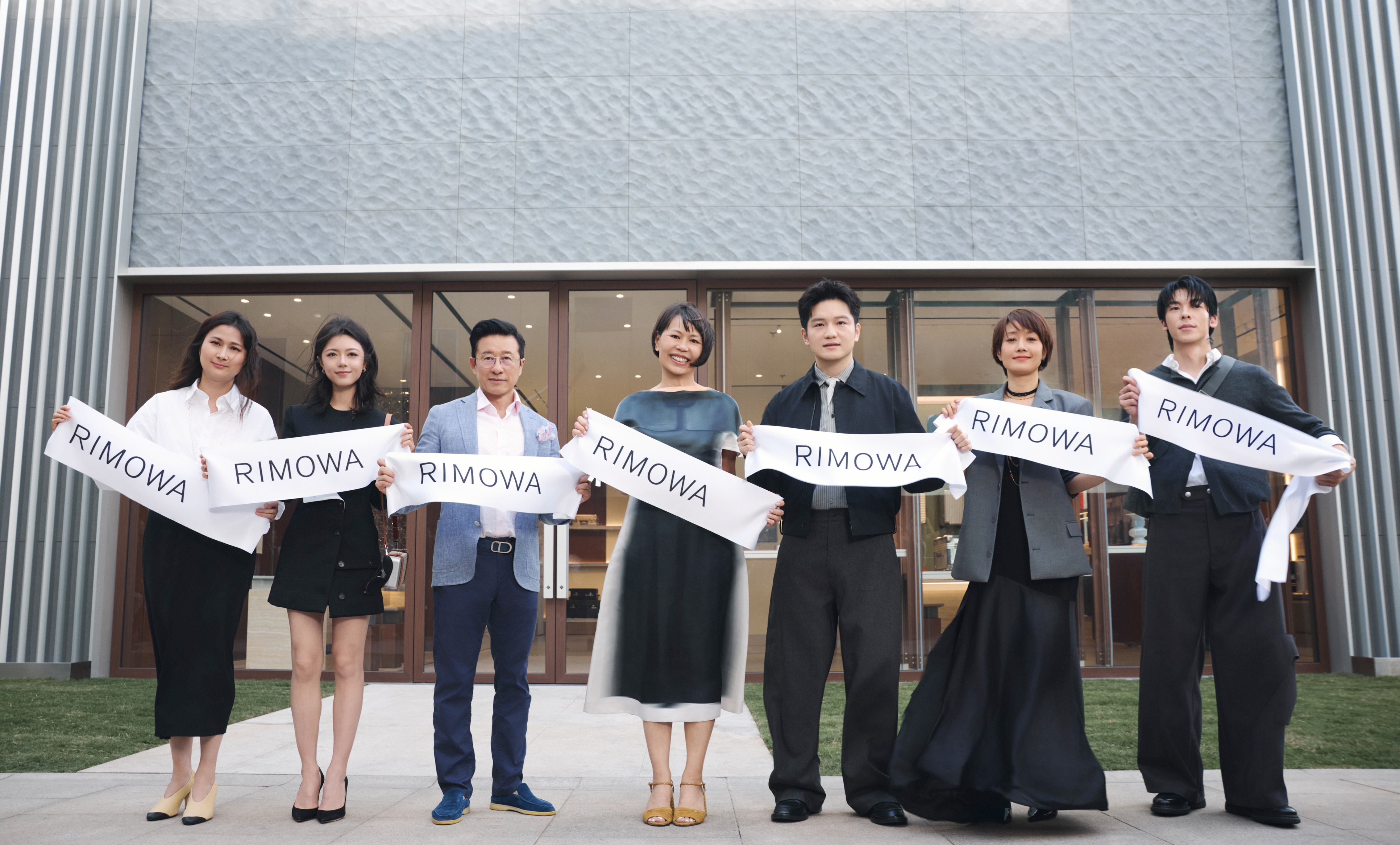
Recent moves by German luxury luggage brand RIMOWA offer a case in point. During the reporting period, RIMOWA rose 10 places in the Vitality Ranking, entering the top 10 for the first time. On September 16, its first flagship store on the Chinese Mainland officially opened at Jing’an Kerry Centre in Shanghai.
A suitcase has a long useful life, so a customer’s relationship with its maker extends well beyond the moment of purchase. For RIMOWA, the flagship is more than a new sales outlet: it also serves to deepen the brand experience and sustain customer relationships. The new store, RIMOWA’s fifth boutique in Shanghai, covers more than 200 square metres. It is the first in China to introduce the RE-CRAFTED programme and also offers the Crafted For You customisation service.

RIMOWA’s flagship store at Shanghai Jing’an Kerry Centre
The store’s approach to local culture goes beyond products and visual design. Around its global theme, “For a Lifetime of Lives,” RIMOWA invited writer and artist Jin Yucheng to present Jing’an Temple and a personal message. It also released a city cultural guide map, Shanghai, For a Lifetime of Lives: Coordinates of Jing’an’s Historic Buildings, bringing more than a dozen historic buildings in Jing’an, along with their engineering details, historical records, and urban memories, into the brand’s story.
From Cologne to Shanghai, RIMOWA is trying to answer a more specific question: how can a global travel brand find local cultural coordinates for its brand theme in the Chinese market?

A Flagship Store Is More Than a Larger Boutique
While the flagship retains RIMOWA’s established retail design language, its most immediate change is an expanded range of services. The new store has a dedicated customer service area, an on-site repair centre and the RE-CRAFTED programme, offered in China for the first time.
RE-CRAFTED is especially noteworthy. The programme centres on the collection, repair and restoration of RIMOWA’s aluminium-magnesium alloy wheeled suitcases. Customers can bring eligible used suitcases to the Shanghai Jing’an Kerry Centre flagship for official assessment and receive a RIMOWA voucher worth RMB 2,000 [approximately USD 298]. The voucher can be used on a purchase of at least RMB 4,000 [approximately USD 596], with one voucher permitted per transaction. Each person may submit up to two suitcases per year.
RE-CRAFTED extends the long-term service system RIMOWA has built around its lifetime guarantee. The brand is looking beyond how long a product can be used, making post-purchase repair, restoration and reuse part of its relationship with customers.
This reflects a broader consumer trend. In Future Consumer 2028, WGSN describes “The Restorers” as consumers inclined to buy fewer, better things. They place greater value on durability, repairability, and materials and craftsmanship that gain value over time. The report also argues that brands need to provide more sustained support over the long term, so their products and services remain useful to consumers through different stages of life.
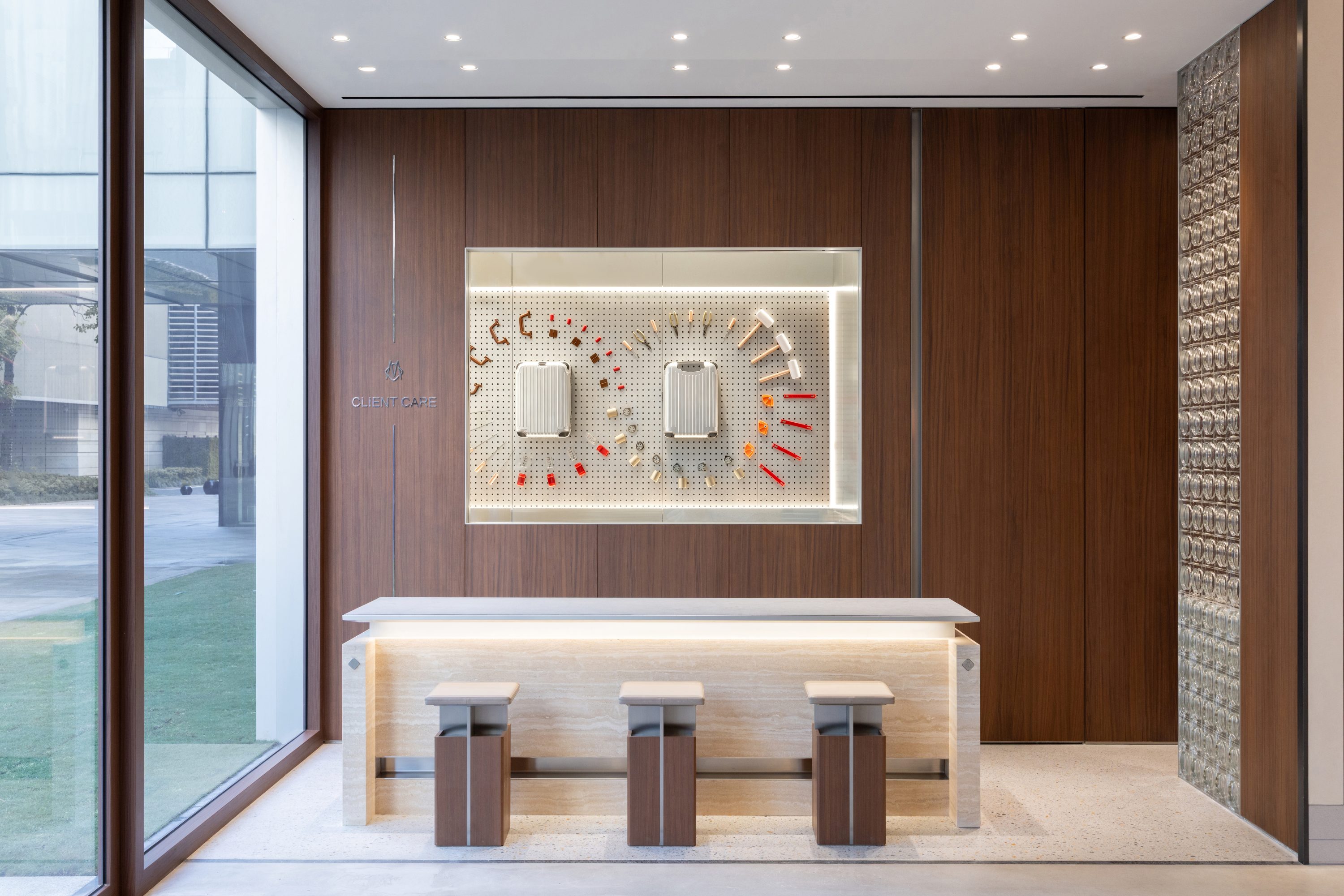
Repair centre with a view of the work in progress
RE-CRAFTED, the lifetime guarantee and customisation services each address a different part of this approach.
The shift also speaks to a practical challenge for luxury retail: when consumers buy durable products that they replace infrequently, how can a brand stay connected with them after the purchase? Rather than simply adding more SKUs, repair, collection and personalisation extend a product’s life cycle.
The flagship is also the first store on the Chinese Mainland to offer the Crafted For You customisation service. Designed and handcrafted by a newly established workshop at RIMOWA’s Cologne factory, the service offers size customisation for Classic aluminium-magnesium alloy suitcases, along with personal choices of lettering, leather, lining, colours and lacquer finishes. More than one million combinations are available, exclusively at the Shanghai Jing’an Kerry Centre flagship for now. The store also exclusively offers two luggage-tag hot-stamping designs depicting Jing’an Kerry Centre and the Jiuqu Bridge at Shanghai’s Yuyuan Garden.

Crafted For You customisation area
Together, these offerings do more than add “Shanghai elements”: they create a more direct connection between the product and the city.
Since joining LVMH in 2017, RIMOWA has continued to expand its product range. With the launch of the Never Still collection of backpacks and accessories in 2020, its offering began to move beyond traditional suitcases. Against this backdrop, the flagship needs to accommodate more than products. It must also make room for accessories, customisation, after-sales services and a growing range of brand content.
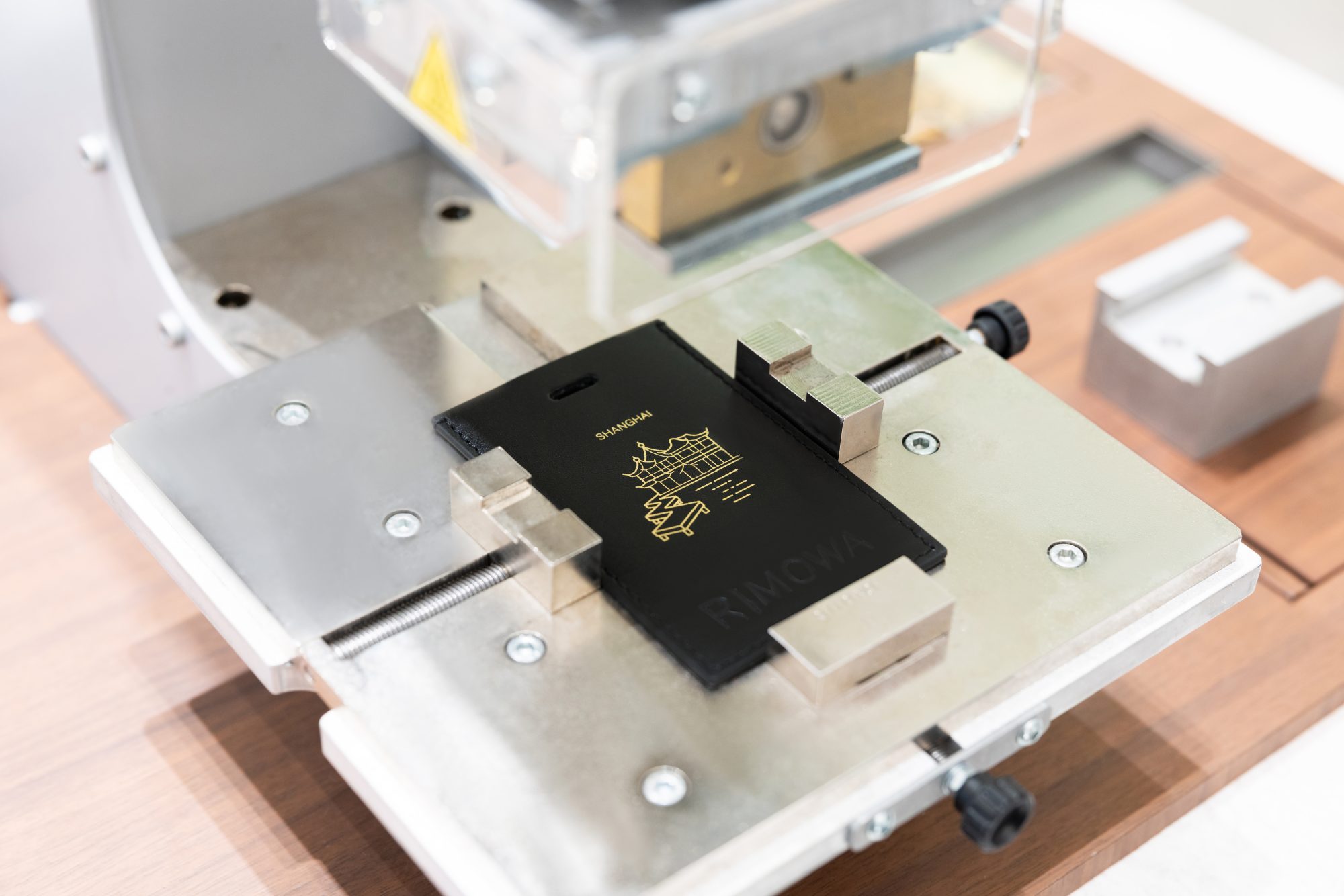
Exclusive Yuyuan Garden luggage-tag hot-stamping design
From Its Origins in Cologne to New Coordinates in Shanghai
If the service system addresses how RIMOWA can sustain customer relationships, the store itself has another role: showing how the brand’s history finds a new expression in Shanghai.
The flagship retains RIMOWA’s clean, modern design language. At the entrance, an aluminium-magnesium alloy installation created by the brand’s in-house architectural team takes the raw aluminium coils used to make its suitcases as its starting point. It turns the journey from raw material to finished product into a spatial experience.
Displaying the manufacturing process is familiar in luxury retail. Its value lies in showing customers the materials and craftsmanship behind the finished product. For RIMOWA, whose identity is closely tied to aluminium-magnesium alloy construction and precision engineering, the raw aluminium coil is also the most immediate expression of where its manufacturing process begins.
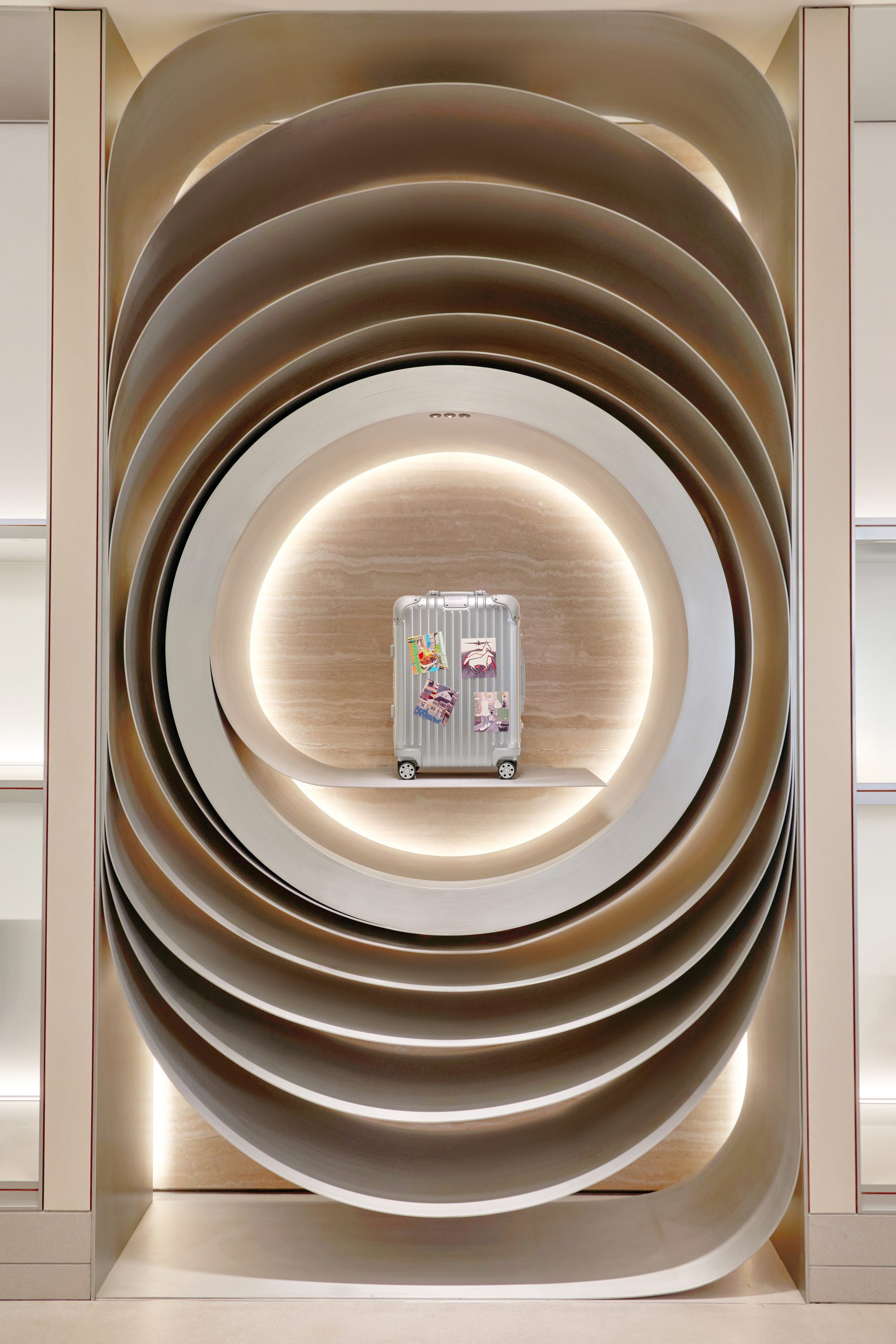
Signature aluminium-magnesium alloy installation
Another prominent feature inside the store is a green display wall bearing two sets of geographical coordinates. According to the brand, its colour draws inspiration from Cologne’s Hohenzollern Bridge. Its grooved structure echoes RIMOWA’s classic suitcase design while also drawing on the cityscape of Cologne Cathedral. The coordinates of Cologne, where the brand was founded, sit alongside those of Shanghai Jing’an Kerry Centre, visually connecting RIMOWA’s origins with its new location on the Chinese Mainland.
“Coordinates” thus become a natural part of the brand’s language. They mark departures and arrivals on a journey, as well as a brand’s path from its place of origin into a new city. In Shanghai, the idea takes on another meaning: if Cologne is RIMOWA’s geographical starting point, Shanghai is becoming a new coordinate for the next chapter of its story on the Chinese Mainland.
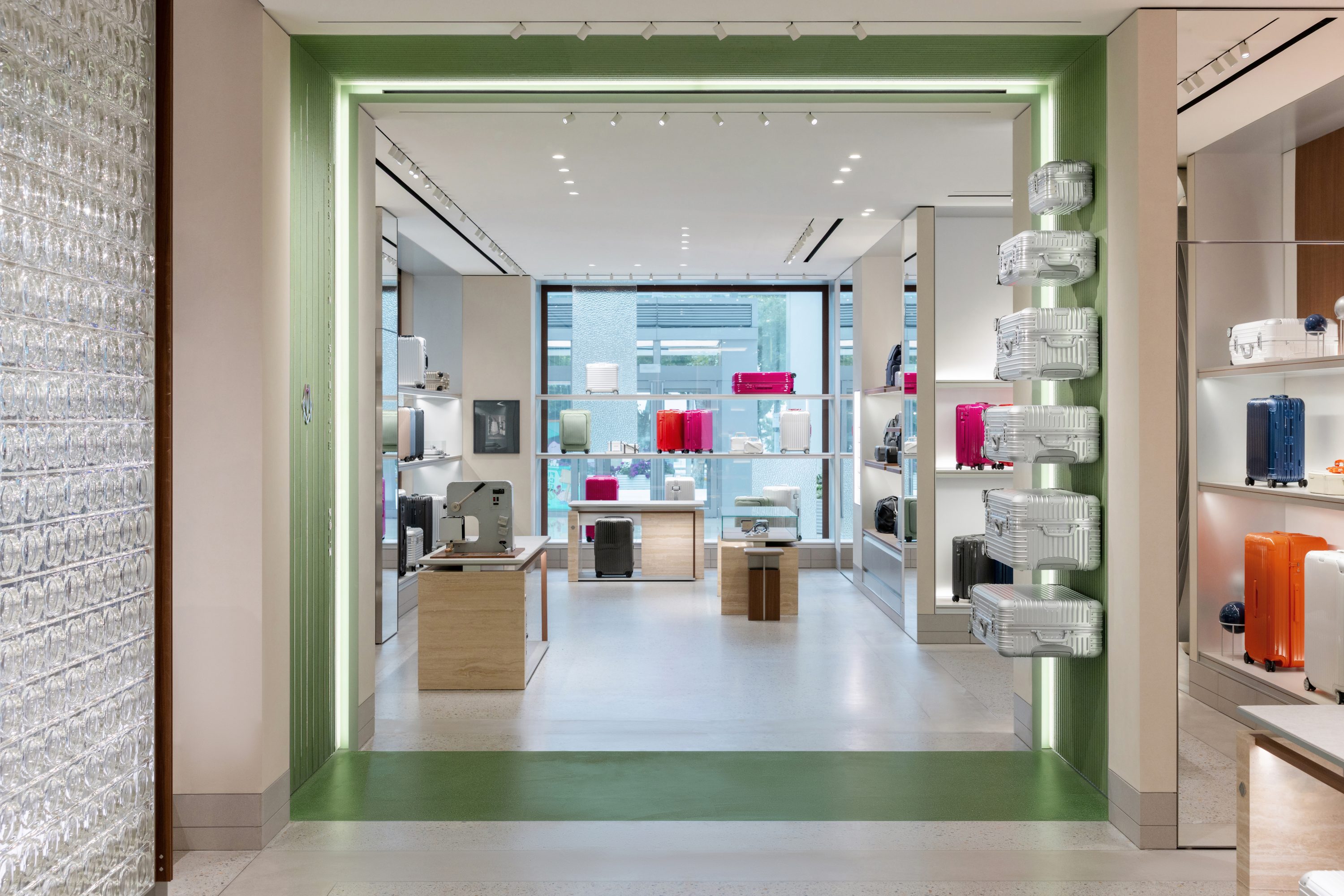
Installation showing the coordinates of Cologne and Shanghai
Displays of traditional craftsmanship at the opening brought this brand language into a Chinese context. Works on display include cultural artefacts restored using the traditional Chinese porcelain-stapling technique by Jiang Daoyin, a nationally recognised inheritor of intangible cultural heritage, as well as works by metalworking artist Chen Yingze. Silver infills and staples stabilise the porcelain while preserving traces of its history; forged silver pieces reveal the textures of the material and the handwork behind them.
These works connect with the ideas of repair and continuity expressed through RE-CRAFTED and the lifetime guarantee. They also echo the Hammerschlag hammered finish on the flagship’s exterior. Their significance lies in a shared, concrete question: how does an object endure the passage of time, retain its marks, and continue to be used through craftsmanship?
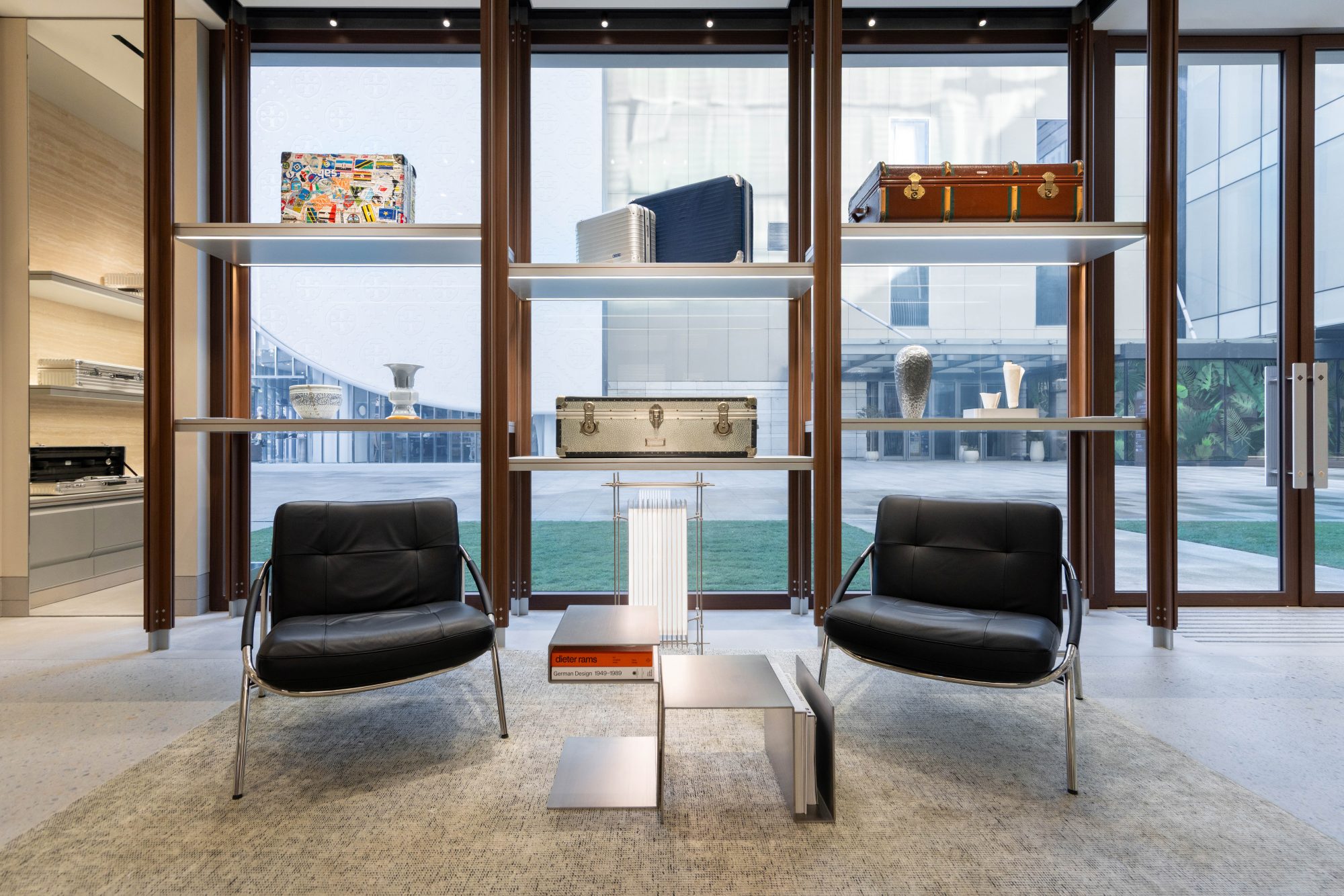
Display wall featuring archival works
From a Suitcase to the Many Lives of a City
The most distinctive part of RIMOWA’s Shanghai opening is a city cultural project centred on Shanghai, For a Lifetime of Lives: Coordinates of Jing’an’s Historic Buildings.
RIMOWA invited writer and artist Jin Yucheng to contribute his work, Jing’an Temple, and a message. It also worked with Shanghai-based architectural research team Dunes Workshop to explore the engineering stories behind historic buildings, starting in Jing’an, where the flagship is located. Rather than treating the map as a simple guide to places to visit, the project examines architectural details such as load-bearing structures, material tolerances, and digital preservation, alongside the buildings’ place in the city’s history.
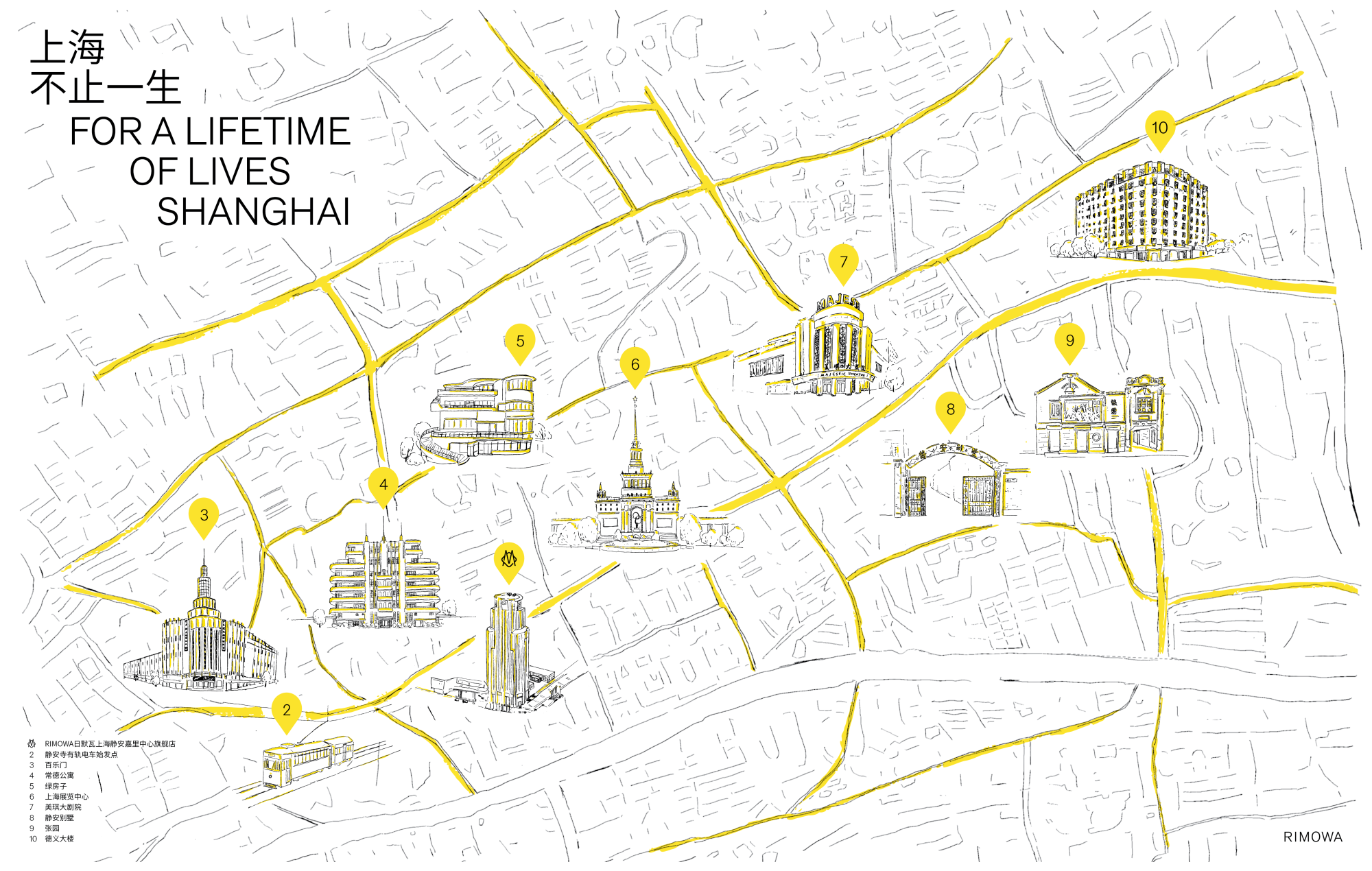
Shanghai, For a Lifetime of Lives: Coordinates of Jing’an’s Historic Buildings city cultural guide map
The guide map connects more than a dozen historic buildings and city landmarks, including the Paramount, Zhangyuan, the Green House, Changde Apartments, the Majestic Theatre and Jing’an Kerry Centre. Its two threads, “Engineering Data” and “History”, bring construction figures, restoration records, historical context, and human stories into the same narrative.
Why architecture? One reason is the clear relationship between these buildings and RIMOWA’s theme of “For a Lifetime of Lives”: both are shaped by time.
Historic buildings do not remain fixed at the moment they are completed. They are restored, relocated, adapted, and given new purposes, continuing to play a part in city life as they change. A RIMOWA suitcase likewise acquires scratches, stickers and signs of wear through years of use, then enters another stage of its life through repair, restoration and reuse.
In the global campaign, “For a Lifetime of Lives” explores how a suitcase accompanies someone through different stages of life. In Shanghai, the theme also speaks to how a city or a building endures through time and continues to exist after change.
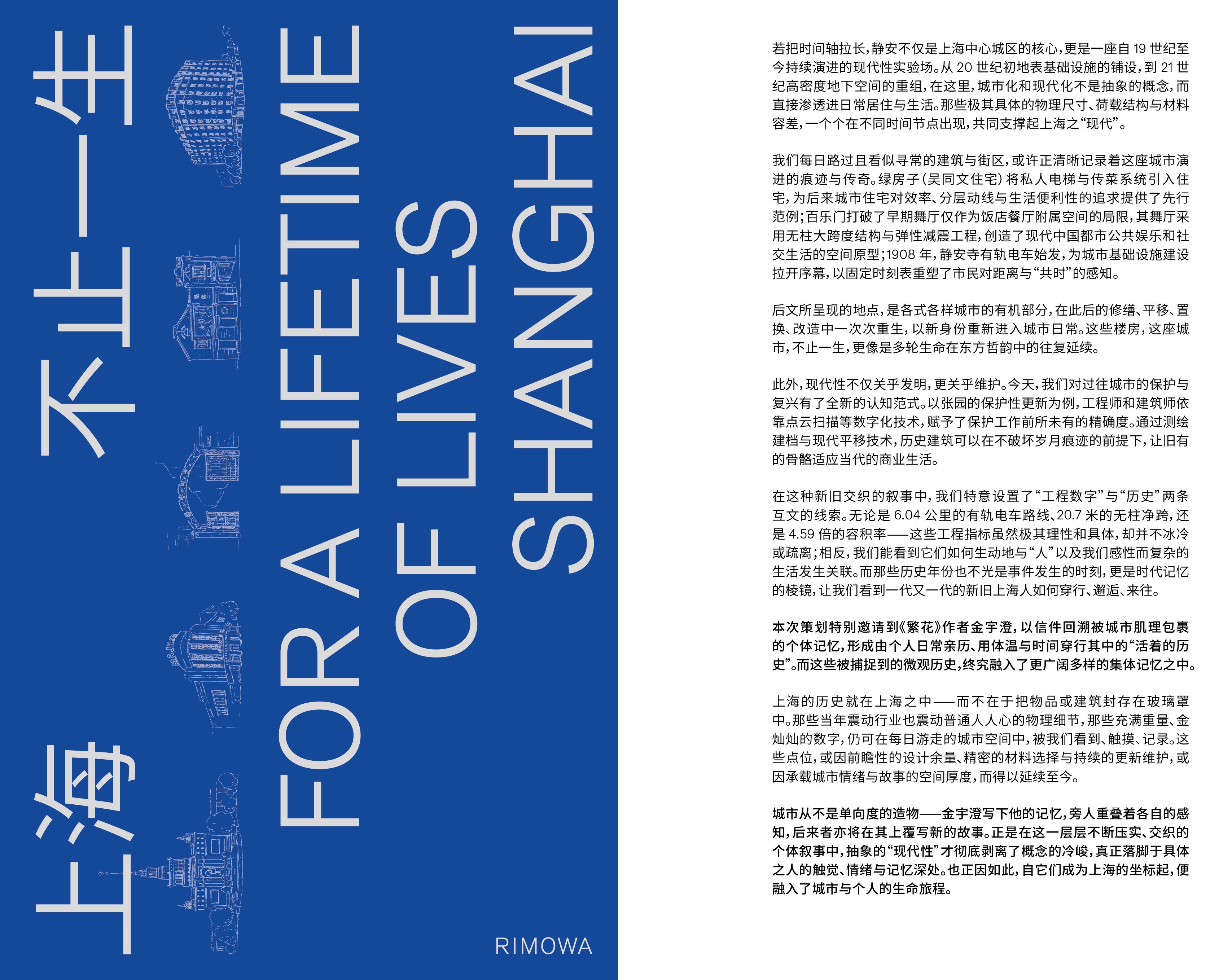
Shanghai, For a Lifetime of Lives: Coordinates of Jing’an’s Historic Buildings city cultural guide map
The value of this interpretation is that it leaves the brand theme intact while giving it a larger setting. For RIMOWA, the question is how objects endure; for Shanghai, it is how a city endures. One extends a product’s life through manufacturing, repair and restoration. The other sustains urban memory through restoration and renewal.
The map’s parallel threads of “Engineering Data” and “History” also reflect two sides of RIMOWA’s identity. One concerns materials, structures, manufacturing and engineering; the other concerns people’s lives, memories and stories of the city. This approach carries more meaning than simply adding a few local symbols: a German travel brand whose identity is rooted in industrial manufacturing is still speaking in its own language, but is beginning to use that language to understand a Chinese city.
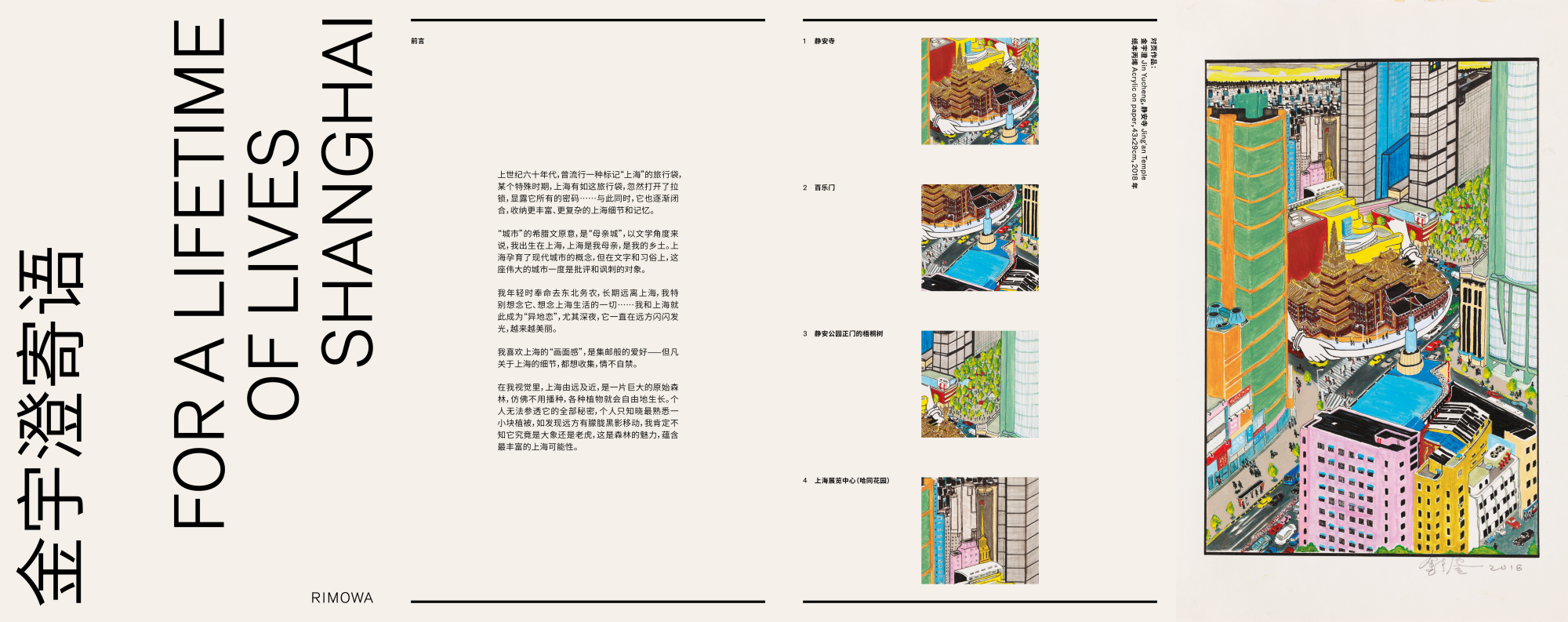
Writer and artist Jin Yucheng’s message accompanying Jing’an Temple
At the opening, the project moved from the map into the store. Jin Yucheng’s works Horse No. 5, Jing’an Temple, Pulley and Among the Bamboo were displayed together and reproduced as limited-edition Shanghai-themed art stickers. The Shanghai, For a Lifetime of Lives city guide map was sent to invited guests in advance as part of their invitations. Meanwhile, 12 custom trumpet pieces from the For a Lifetime of Lives short-film series were pressed onto vinyl records and made available to listen to in the store and at the party.

Jin Yucheng’s works Jing’an Temple, Pulley, Horse No. 5 and Among the Bamboo were reproduced as limited-edition Shanghai-themed art stickers
These elements make the city’s culture more than a display for opening day. They turn it into brand content that people can read, view, and take home. The flagship thus begins to serve a purpose beyond displaying merchandise: it invites customers into the cultural setting the brand has created.
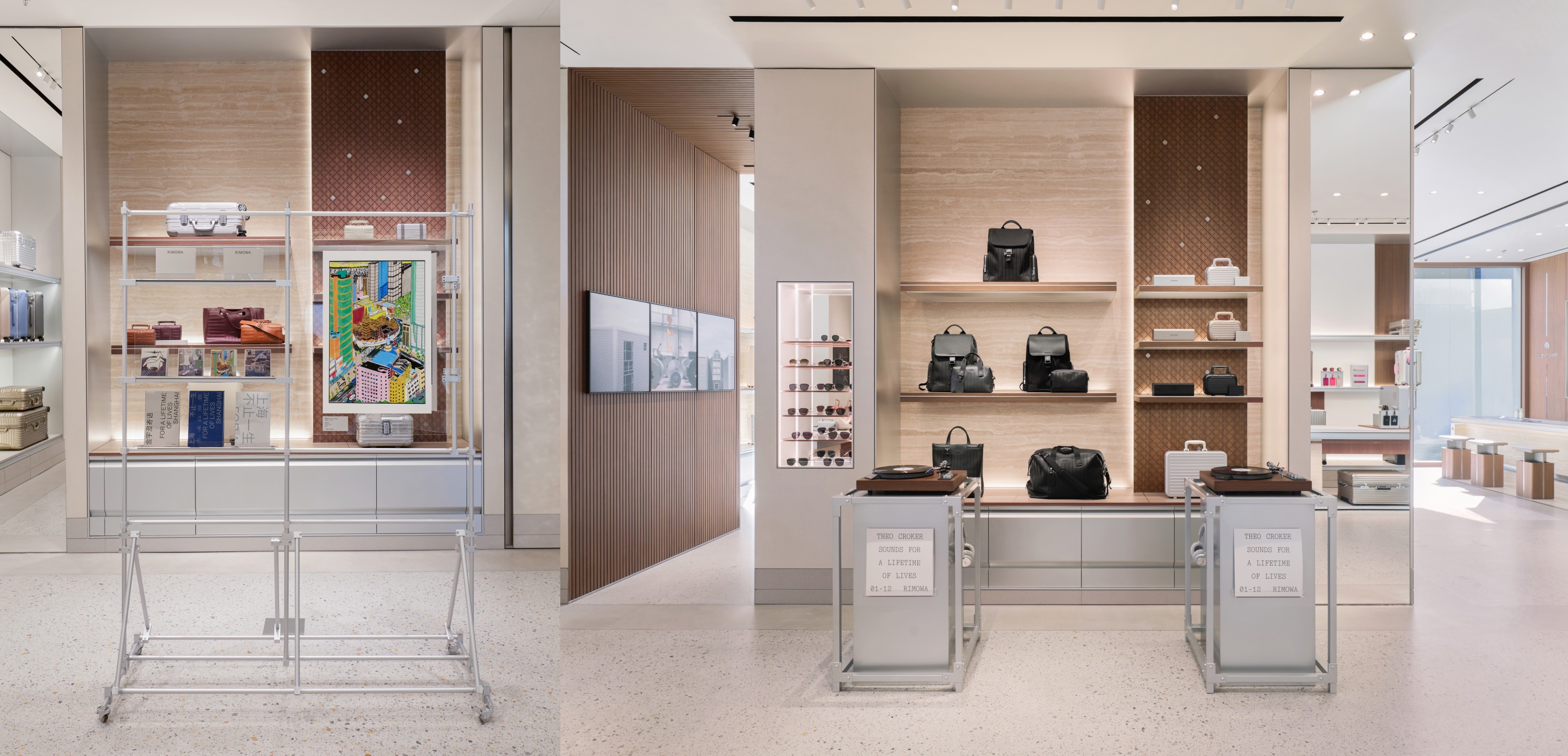
Left: Area featuring works created in collaboration with writer and artist Jin Yucheng; right: RIMOWA’s For a Lifetime of Lives vinyl listening area
From Local Initiatives to a Fuller Chinese Context
Viewed over a longer period, the cultural project at the Shanghai flagship is not RIMOWA’s first attempt to develop this narrative in China. During the brand’s 125th-anniversary exhibition in Shanghai in 2023, Luxe.CO observed that RIMOWA needed to find a more emotional and cultural expression for products known for their engineering performance and durability. Three years later, that exploration has extended into the flagship’s physical space, its services, and cultural content rooted more closely in the city.
Since the start of 2026, RIMOWA has launched several campaigns in China built around products, cities and people. Its limited-time “New Colours, Shu Heritage” event in Chengdu took new colours from the Essential collection as its starting point. Working with the Chengdu Shu Brocade and Embroidery Museum and an inheritor of intangible cultural heritage, it brought Shu brocade patterns and traditional craftsmanship into the brand’s space. The subsequent “Where Extraordinary Journeys Meet” campaign brought together Jay Chou and Fan Zhendong, drawing on music and competitive sport to tell their stories. Custom accessories and a personalised table-tennis racket case extended the product story.
This approach continued in the communications around the Shanghai flagship opening. Friends of the brand, entertainers and creators from different fields were invited to take part, generating content that reached a range of audiences. Fan Zhendong, Zhao Jinmai and Greg Hsu are all friends of RIMOWA. The opening ceremony and party also brought together actor Ma Yili, singer Cao Yang, trumpeter Xiao Wentao, pianist Zhang Haotian, supermodel and independent musician Chen Yu, musician and producer Lin Zihao, nationally recognised intangible cultural heritage inheritor Jiang Daoyin, and metalworking artist Chen Yingze. Together, they represented a wider range of interests and gave the brand more ways to connect with Chinese consumers.
Seen this way, a highly globalised luxury brand does not necessarily need to keep adding more “Chinese elements” to its local communications. It can find connections to its own identity through people, cities and cultural experiences familiar to Chinese consumers.
From the flagship to the city around it, “For a Lifetime of Lives” has gained a new context in China rather than a new visual symbol. A suitcase can carry traces of its owner through time, just as a building can preserve a city’s memories. The flagship brings RIMOWA’s different explorations of products, people, and cities in China together in one setting.
Perhaps this is one of the most valuable ways for a global luxury brand to connect with a particular market: stay true to its established theme while finding local experiences that genuinely speak to it.
| Image Credit: RIMOWA
| Editor: Xiaoyue